
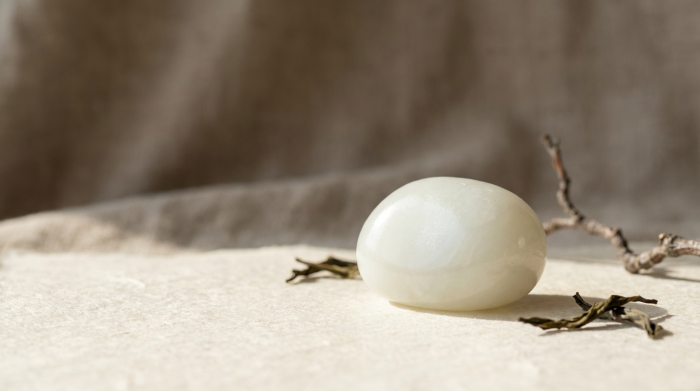
In Confucian thought, jade is not merely a beautiful material — it is a moral technology, a daily practice of self-cultivation embedded in physical form. Wearing jade serves as a bright mirror for self-reflection, fostering reverence and appreciation. Understanding the Confucian philosophy of jade reveals why this stone has been worn, treasured, and passed down through generations as something far more than jewelry.
The Confucian Gentleman and His Jade
Confucius established the enduring principle that a virtuous person should always wear jade: 'A gentleman, for no reason, should not be without his jade' (君子无故,玉不去身). This was not about fashion or wealth display — jade pendants could be quite simple. It was about using physical presence as moral reminder. As the gentleman moved, his jade pendants clinked together with a clear, restrained sound; the Confucian literature is specific that this sound should guide one's pace — not too fast (which would suggest agitation), not too slow (suggesting laziness). The jade pendant became a kind of wearable ethics, calibrating the gentleman's comportment to his values throughout the day. The Confucian text 'Rites of Zhou' specifies exactly which jade ornaments different ranks of officials should wear, encoding the social hierarchy in jade form.
Using Jade to Cultivate Virtue: The Method
The Confucian method of using jade for self-cultivation was systematic. Regular handling of jade — rotating it in the hand, examining its qualities — was a meditative practice, not idle fidgeting. As you felt jade's warmth, you contemplated benevolence. As you observed its translucency, you reflected on wisdom. As you noted its resistance to fracture, you thought about courage. The great Confucian text 'Xunzi' explicitly links each of jade's physical qualities to a specific virtue: its warmth to humanity (仁 rén), its luster to knowledge (知 zhì), its firmness to righteousness (义 yì), its sharp edges that do not injure to justice (义), its sound to music (乐 yuè), its flaws not hidden by its beauty to loyalty (忠 zhōng). Jade was literally used as a mnemonic device for the entire Confucian value system.
The Living Legacy of Confucian Jade Philosophy
Confucian jade philosophy is not an ancient relic — it is a living tradition that continues to shape how Chinese people experience jade today. When a Chinese parent gives a child jade at a significant life moment (birth, graduation, wedding), they are participating in a Confucian tradition of moral gift-giving: the jade is meant to serve as a constant reminder of the virtues the parent hopes the child will cultivate. When jade is kept for generations in a family, it accumulates the intentions and virtues of everyone who has worn and valued it — becoming a moral heirloom as well as a material one. At Safinite, we understand jade as the Confucian tradition understood it: as a material that calls its owner to their highest self. Explore our jade collection or visit the Confucian jade philosophy library.
Frequently Asked Questions
What did Confucius actually say about jade?
Confucius made several important statements about jade recorded in classical texts. The most famous: 'A gentleman, for no reason, should not be without his jade' (君子无故,玉不去身). He also conducted dialogues about jade's virtues, particularly comparing jade's warmth to benevolence (仁), its translucency to wisdom (知), and its firmness to righteousness (义). These statements established jade as a moral material — a physical embodiment of the virtues Confucian philosophy emphasized.
Why did Confucian gentlemen specifically wear jade pendants, not just carry jade?
Wearing jade as a pendant served several purposes. It was always present — a constant physical reminder of virtue, not something set aside and forgotten. The movement of the pendant created sound — the characteristic clink of jade-on-jade that the Confucian texts prescribe as the proper accompaniment to a gentleman's measured walk. And wearing jade against the skin allowed the stone's qualities to be continuously felt — its warmth, smoothness, and weight serving as ongoing tactile moral education. Jade in the hand can be put down; jade worn on the body goes everywhere with its owner.
The Confucian philosophy of jade offers a profound vision of how material objects can serve moral development — how beauty and virtue can reinforce each other in daily life. This vision continues to make jade meaningful in ways no other gem can match. Explore more at our philosophy library, or find your moral companion at Safinite.