
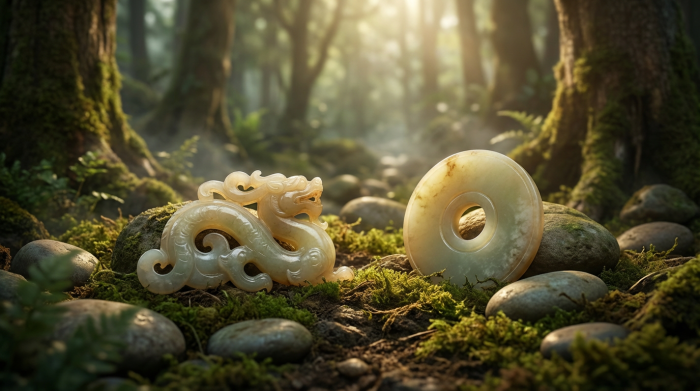
The question 'what is jade?' has a more complex answer than most people expect. Chinese jade culture encompasses several distinct stone types, each with its own character and history. Understanding the differences between them — mineralogically, aesthetically, and culturally — is essential for anyone who wants to navigate the jade market intelligently or appreciate Chinese jade culture deeply.
Hetian Nephrite (和田玉): The Cultural Standard
Hetian nephrite (和田玉, Hétián yù) is the apex of Chinese jade tradition — the material that has been prized for nearly 10,000 years and around which the entire philosophy and aesthetics of Chinese jade was developed. Mineralogically, it is a calcium-magnesium silicate in the tremolite-actinolite series, formed through contact metamorphism deep in the Kunlun Mountains of Xinjiang. The finest grades have a characteristic 'mutton-fat' (羊脂) white with a warm, oily luster — a quality produced by an exceptionally dense, fine interlocking of microscopic tremolite fibers with minimal iron content. Hetian nephrite is remarkably tough — more impact-resistant than steel by weight — due to this interlocking fiber structure. Color ranges from white (most prized) through yellow, green, and black (all natural, caused by varying iron and other mineral content). When held, fine Hetian nephrite has a distinctive warmth and smoothness that collectors describe as feeling 'alive.' All jade mentioned in Chinese philosophical texts (Confucius, Guanzi, Xunzi) refers to nephrite, almost certainly Hetian nephrite — it is the jade of Chinese civilization.
Jadeite (翡翠): The Newcomer with Maximum Color
Jadeite (翡翠, fěicuì) is a sodium-aluminum silicate — a completely different mineral from nephrite despite sharing the 'jade' name. It forms under much higher pressures than nephrite (typically in subduction zones), primarily in Myanmar (Burma), and entered Chinese trade in significant quantities only in the 18th century Qing dynasty. Jadeite's most famous quality is color: the finest 'imperial green' jadeite (颜色极浓、极阳、极均的祖母绿色) is an extraordinary saturated green from chromium content that nephrite can never achieve. Jadeite is also somewhat harder than nephrite (6.5-7 vs 6-6.5 on Mohs scale) and has a different, glassier luster. Jadeite was particularly favored by Empress Dowager Cixi (1835-1908) and became fashionable among Qing nobility. Today, fine jadeite — particularly 'imperial green' with high translucency and perfect color distribution — commands extraordinary prices, often exceeding equivalent nephrite. However, culturally, jadeite carries less historical depth than nephrite: it is 200 years in Chinese tradition rather than 10,000.
Xiuyan Jade (岫岩玉): The Prehistoric Gem
Xiuyan jade (岫岩玉, Xiùyán yù), from Xiuyan County in Liaoning Province, is primarily serpentinite — a different mineral family from both nephrite and jadeite. Softer (hardness 3-5), more susceptible to scratching, and with a different greasy translucent luster, Xiuyan jade is historically important as the material of choice for many northeastern Chinese Neolithic cultures, particularly the Hongshan culture (4700-2900 BCE) whose famous jade dragons and animal figures are made largely from Xiuyan serpentine. The stone ranges in color from pale white through yellow-green to deep green, often with attractive translucency. Xiuyan jade is significantly less expensive than Hetian nephrite and softer — less suitable for jewelry that will receive daily wear, but beautiful in display pieces and appropriate for those drawn to the Neolithic jade tradition.
Dushan Jade (独山玉): The Colorful Nanyang Stone
Dushan jade (独山玉, Dúshān yù) from Nanyang, Henan Province is one of China's 'Four Famous Jade' (四大名玉) along with Hetian, Xiuyan, and turquoise. Mineralogically it is a plagioclase feldspar with various associated minerals — not related to either nephrite or jadeite. Dushan jade's most distinctive feature is extraordinary color variety: a single piece can display white, green, yellow, brown, red, and black zones simultaneously. This color variety makes Dushan jade particularly suited to qiaose (俏色) carving, where the natural color zones become design elements. Archaeological evidence shows Dushan jade use since the Neolithic period, with major workshops at the Huangshan ruins dating back thousands of years. Hardness is 6-7, making it workable and reasonably durable.
Lantian Jade (蓝田玉): The Literary Legend
Lantian jade (蓝田玉, Lántián yù) from Lantian County in Shaanxi Province holds a special place in Chinese literary culture. The Tang dynasty poet Li Shangyin wrote the celebrated lines: 'Blue fields, warm sun, smoke rises from jade.' Lantian jade has been associated with literary beauty and refinement since the Han dynasty. Mineralogically it is a mixture of serpentine, diopside, and calcite — variable properties depending on the zone. It ranges from pale green to yellow-green and white. Lantian jade is historically significant but relatively less commonly encountered as a collecting category today — its value lies primarily in its literary associations and historical importance rather than distinctive physical properties.
Turquoise (绿松石): The Ancient Inlay Material
Chinese turquoise (绿松石, lǜsōngshí), primarily from Hubei Province, is not jade in the mineralogical sense (it is a hydrous copper-aluminum phosphate) but has been used in Chinese culture for over 5,000 years. Turquoise was particularly valued for inlay work — set into bronze vessels, jade objects, and lacquerware to add blue-green color accents. Archaeological finds show turquoise at Erlitou culture sites (possibly Xia dynasty, 2100-1600 BCE). Chinese turquoise ranges from sky blue through blue-green to apple green, with matrix patterns that vary from smooth to heavily veined. It is softer than jade (hardness 5-6) and more porous, requiring careful care.
Frequently Asked Questions
Which type of jade is the best investment?
For investment purposes, certified, high-quality Hetian nephrite seed jade (particularly fine white or lightly yellow-green grades) and imperial-green jadeite have historically shown the strongest appreciation. Both require careful authentication — the market for imitations and treated stones is significant. Exceptional Hetian seed jade has seen dramatic price appreciation as supply has decreased while demand from Chinese collectors has grown. Any jade investment requires certificates from reputable laboratories (NGTC for Hetian jade) and buying from trusted dealers.
What does 'A jade,' 'B jade,' and 'C jade' mean?
'A jade' is untreated natural jade — the only type worth buying for quality or investment. 'B jade' has been bleached (to remove brown/grey staining) and then polymer-impregnated to restore structural integrity and improve appearance. The treatment degrades over time, causing the jade to discolor or become dull. 'C jade' has been artificially dyed to add or enhance color — dye can fade and the treatment significantly reduces value. B and C treatments must be disclosed by sellers but often are not. NGTC certificates confirm A-grade status; Safinite sells only A-grade authenticated jade.
How can I tell nephrite from jadeite with the naked eye?
Several visual clues help distinguish nephrite from jadeite. Nephrite has: a characteristic 'greasy' or 'waxy' luster (warm, diffuse glow); typically ranges from white through yellow and green but rarely vivid pure green; a fibrous internal texture visible under strong magnification. Jadeite has: a slightly glassier luster; can achieve vivid pure greens, lavenders, and reds impossible in nephrite; a granular internal texture (not fibrous). However, these distinctions require practice — the most reliable method for valuable pieces is laboratory testing (specific gravity, refractive index, spectroscopy).
Is green nephrite the same thing as Hetian jade?
Not exactly. 'Hetian jade' (和田玉) in China's national standard (GB/T 16552) refers to all nephrite jade meeting certain quality criteria — including white, yellow, green, and black varieties from various origins, not just Xinjiang. However, in collector usage, 'Hetian jade' typically means nephrite from the Hetian region of Xinjiang (particularly seed jade from the White or Black Jade Rivers). Green nephrite exists both from Xinjiang and from other sources (Canada, Russia, New Zealand). Origin significantly affects value — Xinjiang Hetian nephrite commands the highest premium.
Understanding the diversity of Chinese jade types allows you to make informed choices and appreciate each stone on its own terms. At Safinite, we specialize exclusively in certified authentic Hetian nephrite — the material at the heart of Chinese jade tradition for ten thousand years. Explore our authenticated collection or visit our complete jade guide to learn more.