
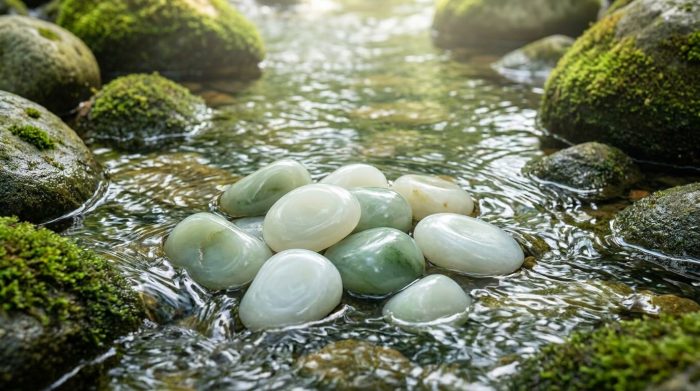
Somewhere high in the Kunlun Mountains — at altitudes where the air grows thin and the sky turns a blue so deep it becomes violet — a piece of jade separates from the rock that formed it. Perhaps after an earthquake. Perhaps after centuries of frost working silently into a crack. It falls. It tumbles. It enters a stream.
And then something extraordinary begins: the river takes over.
For a thousand years, perhaps ten thousand, the jade rolls in the current. The water carries it downstream during spring floods and lets it rest in quiet pools during summer. Other stones grind against it. The river sings over it. The cold of glacial water and the warmth of valley sunlight alternate across its surface, season after season, century after century.
When a human hand finally lifts it from the riverbed, the jade that emerges is not the same stone that left the mountain. The river has given it something the mountain never could: a smoothness that feels almost like skin. A warmth that seems almost like memory. A natural russet “skin” on its surface — the color of autumn leaves or old gold — that is the visible record of all those centuries of patient water.
This is seed jade — and in the long tradition of Eastern jade culture, it is the most revered jade of all.
The Mountain and the River: Two Ways of Being Jade
Jade from the mountains is noble in its own right. Freshly quarried, it has the angular character of something that has never been touched — sharp edges, strong color, the unapologetic presence of raw stone. Expert eyes can read its veins, its subtle variations, its potential. Mountain jade is the jade of possibility.
But seed jade is the jade of completion.
The river, over thousands of years, does what no carver’s wheel can accomplish. It removes everything that is not essential. It smooths away the brittle, the angular, the accidental. What remains is jade at its most concentrated — the portions that were strong enough, pure enough, dense enough, to survive the river’s long and honest judgment.
Connoisseurs call seed jade’s natural skin “the certificate of nature” — because it cannot be faked. The specific colors (russet, amber, black, ivory) and the way the skin wraps the stone tell an expert everything: which river, roughly which era, what quality lies beneath. It is a document written in geology and time.
The Warmth That Defies Explanation
Fine Hetian nephrite is most prized in what the tradition calls mutton-fat white: a creamy, semi-translucent white with a subtle oiliness, like the surface of the finest silk soaked in warm light. But “white” is far too simple a word. The color contains faint suggestions of warmth — the barest hint of ivory, of candlelight, of a winter morning just before the sun appears.
Hold a fine piece of Hetian seed jade. It is cool at first. Then, within seconds, it warms to your body temperature — not merely absorbing your warmth, but meeting it, as if the stone has been waiting for this exact exchange. The ancient tradition described this as wen run: warm and moist. A quality that no gemological instrument has ever fully quantified, but that every human hand immediately recognizes.
“Warm, smooth, and tough — gold and silver cannot be exchanged for it.”
— Eastern proverb on Hetian jade
What the River Teaches
The miners who worked the rivers of the ancient jade-producing regions knew something that later cultures have had to relearn: the river is a better judge of jade than any human being. Give it time, and it will tell you what is truly valuable by keeping it, and what is not by destroying it.
Perhaps this is why seed jade feels different from other jade — not just in texture, but in meaning. When you hold it, you hold something that has been tested. Something that survived not because it was protected, but because it was genuinely strong enough to endure. Something the river tried to break and could not.
In a world full of things that look valuable but are not, there is something deeply reassuring about holding a stone whose worth has been proven by ten thousand years of honest water.