
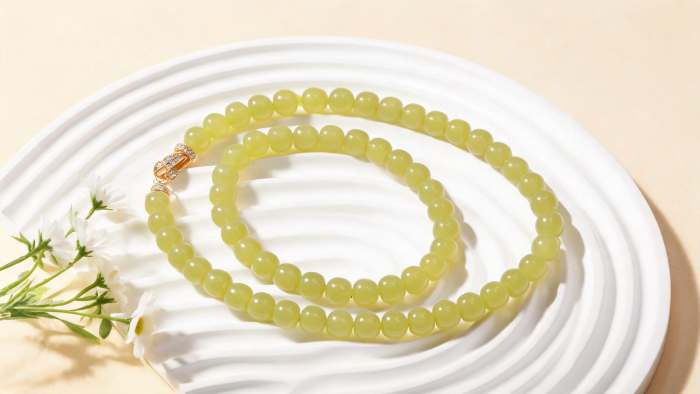
In the spiritual world of the Chinese people, a fine piece of jade is far more than just a treasure. 'A beautiful stone is called jade,' and among this dazzling galaxy of jade, Hetian Jade is undoubtedly the most brilliant star. It is not merely a product of geological activity but a vessel for ten thousand years of Chinese civilization—a warm, storied 'Soul Stone of the East.' Today, let us together unveil its mystery, from science to culture, and understand what true Hetian Jade is.
1. Scientific Essence: The Resilient Body of Tremolite
Composition Analysis:
Its main component belongs to the tremolite-actinolite series, and it may contain accessory minerals such as calcite and graphite, which together create its unique texture.
Physical Properties:
It has a Mohs hardness between 6.0 and 6.5, a refractive index of approximately 1.60–1.61, and exhibits the typical luster of jade.
Core Identification Factor:
Density is key to identification, with a standard value of 2.95 g/cm³ (allowing for slight variations), providing the basis for the 'hydrostatic weighing method.'
The Mystery of Its Toughness:
Hetian Jade's exceptional toughness stems from its unique fibrous interlocking structure (or felted structure). On a microscopic level, countless tiny mineral crystals are tightly 'woven' together, giving it a dense texture, a warm and smooth feel, and resistance to breakage.
2. The Four Forms: A Journey Nurtured by Heaven and Earth
The value of Hetian Jade is closely related to its form. Based on its formation and discovery environment, it is mainly categorized into four types, like four chapters in a story told by nature:
- Mountain Material : Mined from primary deposits in the Kunlun Mountains, blocky with distinct edges and angles, like raw jade in its infancy.
- Mountain Stream Material : Formed when primary ore collapses due to weathering and is briefly transported and eroded by water. Its edges are slightly rounded, and its texture lies between Mountain Material and Seed Material, representing a transitional form.
- Seed Material: This is the 'pride' of Hetian Jade. Primary ore, after millions of years of glacial and flood transport and erosion, becomes pebble-shaped in the middle and lower reaches of rivers. It often possesses a precious layer of natural skin color and distinctive 'pores,' with the finest, most oily and smooth texture, making it the most valuable.
- Gobi Material : Primary ore transported to the Gobi desert, polished over eons by wind and sand. Its surface often shows uneven wind erosion marks, with excellent oiliness and a rugged, weathered beauty.
3. A Spectrum of Colors: One Jade, One World
Hetian Jade is not just white. National standards classify it into a rich variety based on color:
- White Jade: Predominantly white, with 'Mutton Fat' White Jade being the top grade, requiring exceptional whiteness, fineness, and oiliness.
- Green Jade (Qing Yu): Ranging from pale green to deep green, it is produced in relatively large quantities, with a serene color, often used for large vessels.
- Green Jade (Bi Yu) / Jasper: Exhibits an emerald green due to elements like chromium and iron, often accompanied by characteristic black spots, making it bright and vibrant.
- Black Jade (Mo Yu): Appears jet black throughout due to fine graphite inclusions within, creating a rich, deep, and imposing look.
- Brown Jade (Tang Yu) / 'Sugar Jade': Formed by oxidation and staining from iron, resulting in a warm, brownish-yellow hue resembling brown sugar.
- Others: Additionally, there are Yellow Jade, Black and White Jade ('Qing Hua Yu'), and rarer varieties like lavender and cuìqīng (greenish-blue), creating a colorful spectrum.
4. The Soul of Culture: Virtue Embodied in Jade, A Legacy of Millennia
If science grants Hetian Jade its physical life, then Chinese culture imbues it with an immortal soul. The concept of 'The gentleman compares his virtue to jade' is deeply ingrained. The ancients personified jade, endowing it with five supreme virtues:
- Benevolence (Ren) : Warm, smooth, and lustrous, symbolizing a compassionate heart.
- Righteousness (Yi) : Hard in texture, with clear edges that do not cut, symbolizing morality and principle.
- Wisdom (Zhi) : Produces a clear, melodious, and lasting tone when struck, representing wisdom and foresight.
- Courage (Yong) : Extremely tough, unyielding even under pressure, akin to courage and fortitude.
- Integrity (Jie) : Flaws do not obscure its beauty, nor does its beauty conceal flaws, symbolizing pure and upright character.
Conclusion: An Eastern Token Transcending Time
Today, Hetian Jade has long surpassed its role as mere ornamentation, becoming a multidimensional art form that integrates rare material, masterful craftsmanship, and profound culture . It is both a crystallization of hundreds of millions of years of the earth and a physical embodiment of the Eastern philosophical spirit of 'adhering to the mean and achieving harmony.' Whether you are drawn by its unique greasy luster and warm, smooth feel , or moved by the temperance of a noble scholar it represents, understanding Hetian Jade is like opening a door to millennia of Eastern aesthetics and wisdom. It is silent, yet speaks volumes.