
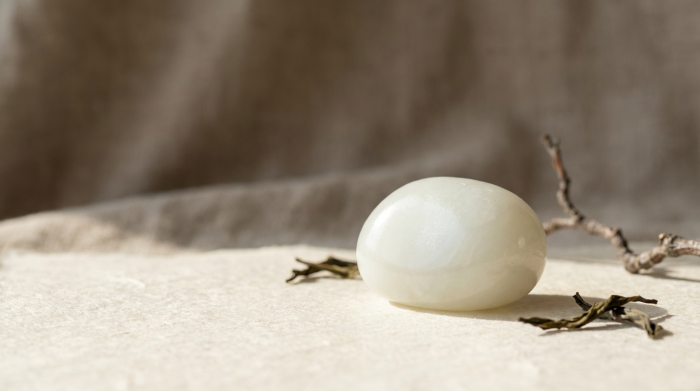
Before the caravans carried silk. Before the merchants knew the word “trade.” Before anyone had thought to call the great mountain passes by any name at all — the jade was already moving.
Archaeologists have found jade from the highland ranges of Central Asia in burial sites scattered across a region spanning thousands of miles. These discoveries predate the Silk Road by millennia. They tell a story so old it barely fits inside recorded history: the story of human beings, separated by deserts and mountain ranges and vast continental distances, discovering beauty — and immediately wanting to share it.
This network of routes — now called the Jade Road — was not a road in any formal sense. It was an impulse made geographic. The impulse that says: I have found something extraordinary. Someone else must see it.
Before the Silk Road: Five Thousand Years of Connection
The movement of jade across the ancient world is one of the oldest stories of human connectivity we can trace. Archaeological evidence places jade trade routes in operation more than five thousand years ago — centuries before the pyramid builders of the Mediterranean, before the earliest written records of any civilization.
These routes followed natural geography: the river valleys, high mountain passes, and oasis settlements that would later become the waypoints of the Silk Road. Where the Silk Road carried goods in both directions — silk westward, glassware eastward, ideas and religions in every direction — the Jade Road had a different character. It was directed by beauty. Fine nephrite jade moved from its highland sources outward into the world, and wherever it arrived, it left a mark on the culture that received it.
A carved jade pendant found in one region might carry decorative motifs traceable to communities thousands of miles distant. Jade was not merely trade. It was conversation. It was the oldest international language, and it was spoken entirely in beauty.
What Jade Meant Across Cultures
Every civilization that encountered fine jade responded with something that exceeded ordinary appreciation. The stone seemed to speak to something universal in human experience: a desire for beauty that endures, for materials that carry meaning beyond their immediate appearance, for objects that feel, somehow, more real than the ordinary world.
In the ancient East, jade was sacred — the medium through which human beings communicated with the spirit world. In Central Asian traditions, jade amulets protected warriors and travelers. Along the western reaches of the Jade Road, jade was prized for its association with immortality, with the preservation of the body and spirit beyond death.
Different meanings. One stone. This multiplicity of interpretation may be precisely why jade traveled so well across cultural boundaries: it could mean different things to different people while remaining, at its core, the same profoundly beautiful, enduring, and quietly authoritative material.
“The Silk Road was long. The Jade Road came first. Both were routes not merely for goods, but for the ideas and values that beauty carries.”
Beauty as the Original Language
The Jade Road reminds us of something we perpetually forget in our age of instant connectivity: human beings have always been connected across vast distances. Not by technology. Not by shared language. But by beauty. By the recognition, when one human being shows another something extraordinary, that beauty does not require translation.
When you hold a piece of jade today, you participate in a conversation that began before recorded history and has never fully ended. The stone in your hand may have traveled across mountain ranges, across deserts, across cultural boundaries, through a chain of human hands each drawn to the same quality you feel now: the warmth, the weight, the sense of something immeasurably old and quietly alive.
That is not nostalgia. That is continuity — the long, unbroken thread that connects the first person who ever looked at a piece of jade and felt something they could not quite name, to you, now, reading these words.
The road is still open. The conversation is still happening. All you have to do is hold the stone.