
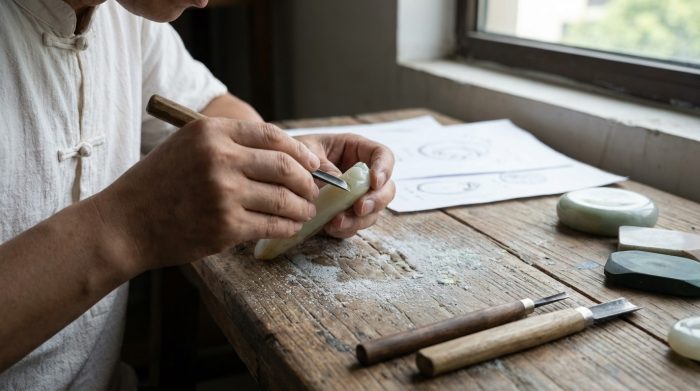
The master carver does not begin by cutting.
He begins by looking. By turning the raw stone in his hands, over and over, in different lights, at different angles. He notes where the color gathers and where it fades. He traces the natural inclusions — what some might call flaws — with his fingertip. He holds the stone up to the light and watches what the light does when it enters. He puts it down. He picks it up again. He looks some more.
Days may pass before he makes the first cut.
This is the ancient principle at the heart of jade carving, stated in the classical tradition with characteristic concision: “Follow the material; apply the art. Turn flaws into beauty.” The carver does not impose his vision on the stone. He discovers the vision the stone already contains, and helps it become visible.
This is not merely technique. It is philosophy. And it is the reason why the greatest works of jade carving do not feel made. They feel revealed.
Why Jade Carving Is Unlike Any Other Craft
Jade cannot be carved with a blade. It is harder than steel, harder than iron, harder than most things that human beings use to cut other things. The traditional carver works with tools embedded with abrasive materials harder than jade itself — powdered corundum, quartz, garnet — and proceeds by gradually grinding away the stone’s surface, one patient pass at a time. There is no rushing this. There is no shortcut. A complex jade carving may require months of daily work, or years.
This fundamental constraint shaped the entire aesthetic of jade carving. Every line had to be intentional, because every line was expensive in time and effort. Every form had to justify itself, because there was no erasing a cut once made. Jade carving is, of necessity, a craft of absolute commitment — which is perhaps why the objects it produces feel so definitive, so entirely themselves.
The Great Techniques
Relief carving raises designs above the background surface — creating depth, shadow, and a sculptural presence that changes as light moves across it. A carved jade mountain, rendered in relief, seems to recede into real distance.
Round carving produces fully three-dimensional forms: jade figures of animals, human forms, mythological beings, rendered with smooth, flowing lines that invite the hand as much as the eye. The finest round carvings feel alive when held — not because of any mystical property, but because of the extraordinary precision with which the carver has followed the natural logic of the form.
Openwork carving is the tradition’s most technically demanding achievement: removing stone to create a structure of pierced, lace-like forms through which light passes. A piece of openwork jade is not the same object in different lights — it is a different object, the shadows shifting, the patterns changing, the whole thing alive with movement. Achieving this in a material that cannot be cut, only ground away, atom by patient atom, is a feat that still astonishes modern engineers.
“Jade must have work; work must have pattern; pattern must have meaning; meaning must be auspicious.”
— Classical Eastern principle of jade carving
The Carver and the Stone: A Love Story
The great master carver Lu Zigang of the Ming dynasty became legendary not for working faster or harder than his peers, but for something more elusive: an ability to find in each stone exactly and only what it wanted to be. His pieces are immediately recognizable — not by their complexity, but by their rightness. Every one of them looks inevitable, as if it could not have been otherwise.
The Eastern aesthetic tradition has a term for this quality: yi jing, or artistic conception. It is the ability to suggest an entire world through a gesture, to evoke a feeling so completely that the viewer’s imagination fills in everything the artist left unsaid. A carved jade mountain does not need to depict every rock and tree. It needs only to capture the feeling of mountain — the quality of height, of stillness, of something that has existed long before human beings and will exist long after.
The carver who achieves yi jing is not competing with nature. They are completing a conversation that nature began, in the dark, millions of years ago, when the first minerals locked together in the earth and began, slowly and patiently, to become jade.
The carver finishes what the earth started. The earth, in turn, makes possible what the carver alone never could.
That is the conversation. It has been ongoing for five thousand years. Every great piece of carved jade is another exchange in it — another moment when the human and the geological meet, listen to each other, and produce something that neither could have made alone.