
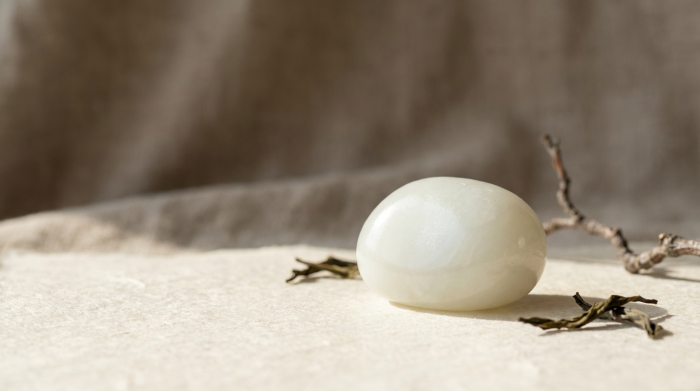
China's jade story begins in the Neolithic period — long before writing, bronze, or civilization as we now understand it. Ancient gentlemen carried jade on their person as a personal adornment and reminder. Archaeological evidence shows that jade was central to ritual life in China more than 8,000 years ago, making it one of humanity's oldest continuous cultural traditions.
The Neolithic Jade Cultures: Where It All Began
China's Neolithic jade cultures span roughly 7,000 BCE to 2,000 BCE, and they were not a single culture but a constellation of regional traditions, each developing distinctive jade forms. The Xinglongwa culture (6200-5400 BCE) in Inner Mongolia produced some of China's earliest known jade ornaments — simple rings and earrings that already show sophisticated jade-working technique. The Hongshan culture (4700-2900 BCE) created extraordinary jade animal sculptures: pig-dragons, owls, turtles, and the famous C-shaped jade dragon — a form that became the archetype of Chinese dragon imagery. Liangzhu culture (3400-2250 BCE), centered in the Yangtze Delta, produced the most sophisticated Neolithic jade of all: elaborately carved Cong tubes and Bi discs, inlaid with intricate divine-human-animal masks requiring tools and skills that still astonish modern jade experts.
Ritual, Power, and Jade in Ancient China
The jade objects of China's Neolithic cultures were not ornaments in any simple sense. They were ritual implements — objects used to communicate with spiritual forces, legitimate authority, and mark the passing between worlds (life and death). Jade Bi discs (flat rings) were placed in graves facing upward, connecting the deceased to heaven. Jade Cong tubes (square outside, circular inside) embodied the intersection of earth (square) and heaven (circle). Animal-form jades (dragons, birds, pigs) were totemic symbols connecting clans to their spiritual ancestors. The extraordinary care and skill invested in making these objects — at a time when stone tools were the only available technology — tells us that jade held the highest possible cultural importance. It was literally the most valuable thing a person could own or offer.
The Jade Age: From Neolithic to Historical China
By the time Chinese civilization entered the historical period — with the Xia and Shang dynasties beginning around 2100-1600 BCE — jade had already accumulated 5,000 years of cultural significance. The ritual forms developed in the Neolithic (Bi discs, Cong tubes, Gui scepters, Zhang tablets) became standardized ceremonial implements in the Zhou dynasty (1046-256 BCE), codified in ritual texts like the Rites of Zhou. The jade tradition did not begin with civilization — civilization inherited and elaborated a jade tradition already ancient when writing was invented. This depth of history explains why jade carries such extraordinary cultural weight in China: it is not a fashion or a luxury, but a continuous thread connecting modern Chinese people to their deepest civilizational roots. Explore this history at Safinite's jade culture center or browse our collection.
Frequently Asked Questions
What is the Hongshan culture and why is its jade famous?
Hongshan culture (4700-2900 BCE) flourished in what is now Inner Mongolia and Liaoning Province. Its jade is famous for several reasons: extraordinary craftsmanship using only stone tools; distinctive animal forms including the famous C-shaped pig-dragon (玉猪龙) that became the archetype of the Chinese dragon; ritual function in a sophisticated religious system centered on shamanic practices. Hongshan jades were made primarily from Xiuyan serpentine, not Hetian nephrite, but their artistry is unmatched for their era.
What is a jade Cong and what did it represent?
A jade Cong (琮) is a tube, square on the outside and circular on the inside, associated primarily with Liangzhu culture (3400-2250 BCE). The square exterior represented earth; the circular interior represented heaven. The Cong was thus a physical model of the cosmos — earth containing heaven, or the intersection of earthly and heavenly forces. Many Cong are elaborately carved with divine-human-and-animal mask imagery, suggesting their use in shamanistic rituals connecting the human world to higher powers.
The ancient jade cultures of China represent one of humanity's most remarkable cultural achievements — sophisticated artistic and spiritual traditions developed over thousands of years before recorded history. At Safinite, we honor this legacy with every piece of certified Hetian nephrite jade. Explore more at our jade knowledge library or browse our collection.