
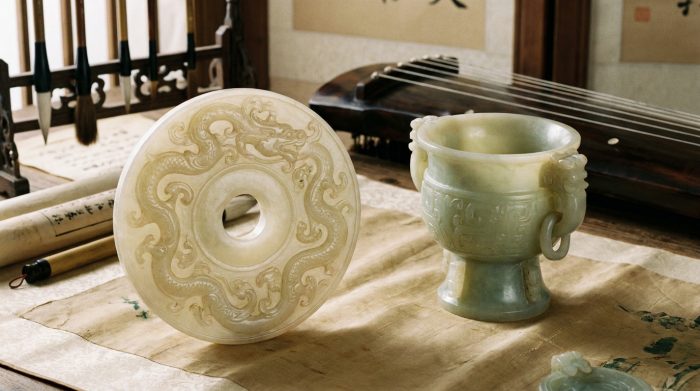
Chinese philosophical traditions are deeply intertwined with the natural world, and jade holds a special place in all three major schools of thought. The history of jade in Chinese civilization stretches back nearly ten thousand years. Understanding how Confucianism, Buddhism, and Taoism each interpret jade reveals the full depth of this stone's cultural significance.
The Confucian View: Jade as Moral Mirror
For Confucian thinkers, jade was primarily a moral material — a physical embodiment of the virtues a gentleman (junzi) should cultivate. Confucius himself compared the qualities of jade to the qualities of a noble person: its warmth to benevolence, its translucency to wisdom, its toughness to courage, its purity to moral integrity. The Confucian gentleman wore jade pendants as a constant reminder of these virtues — the sound of jade clinking as he walked served as an auditory reminder to maintain dignified, measured movement. This practice transformed wearing jade from ornamentation into a daily spiritual discipline. The great Confucian texts, from the Analects to the Rites of Zhou, are filled with jade references that encode moral teachings in material form.
The Taoist and Buddhist Perspectives on Jade
Where Confucians saw jade as a moral mirror, Taoists saw it as a model of natural perfection. Jade forms without human effort, over millions of years, following the natural Way (Tao) of the universe. The Taoist concept of wu wei (non-action, or effortless action) finds a perfect emblem in jade: the stone achieves its perfection by yielding to natural processes, not by forcing itself into shape. The finest jade carvers — working in the Taoist spirit — speak of 'listening to the stone' rather than imposing a design upon it. Buddhist tradition found in jade a metaphor for Buddha nature: like jade, which is precious even when hidden in rough rock, Buddha nature is present in all beings even when obscured by ignorance and desire. The act of polishing jade — revealing the beauty hidden within — parallels Buddhist practice of revealing one's inherent enlightenment.
Jade as Universal Spiritual Symbol
The remarkable fact that Confucianism, Buddhism, and Taoism all found profound meaning in jade — from their very different philosophical perspectives — speaks to jade's extraordinary position in Chinese spiritual life. Jade doesn't belong exclusively to any one tradition; it transcends them all and serves as a meeting point where China's diverse philosophical currents converge. This is why jade remains meaningful to Chinese people regardless of their specific religious or philosophical orientation. It is a cultural universal, a shared symbol of the best that human beings can aspire to. Whether you approach it as a moral reminder (Confucian), a natural wonder (Taoist), or a metaphor for inherent goodness (Buddhist), jade speaks to something deep in the human spirit. Explore this tradition at Safinite's jade culture center or browse our collection.
Frequently Asked Questions
What is the concept of jade's 'virtue' (德) in Chinese philosophy?
In Chinese philosophy, 'virtue' (德) refers to the inherent qualities or powers of a thing — its essential nature. Jade's 'virtue' encompasses all its remarkable physical properties: warmth, luster, toughness, smoothness, translucency, and the distinctive sound it makes when struck. These physical virtues were seen as expressions of a deeper, moral virtue. By surrounding oneself with jade — wearing it, handling it, displaying it — a person could absorb and cultivate these virtues in their own character. The stone was literally seen as morally educational.
How does jade connect Confucian ritual with Buddhist and Taoist practice?
All three traditions emphasize the importance of practice — repeated, mindful action as a path to transformation. Confucian ritual with jade (wearing pendants, using jade in ceremonies) cultivates virtue through repetition. Buddhist meditation using jade objects or contemplating jade metaphors quiets the mind. Taoist carving of jade embodies wu wei — effortless action in harmony with natural form. The common thread is jade as a focus for disciplined practice aimed at human transformation.
The meeting point of Confucianism, Buddhism, and Taoism in jade culture reveals the stone's deepest significance: it is a universal symbol of human aspiration toward virtue, naturalness, and wisdom. Explore more at Safinite's jade library or find your perfect piece in our authenticated collection.