
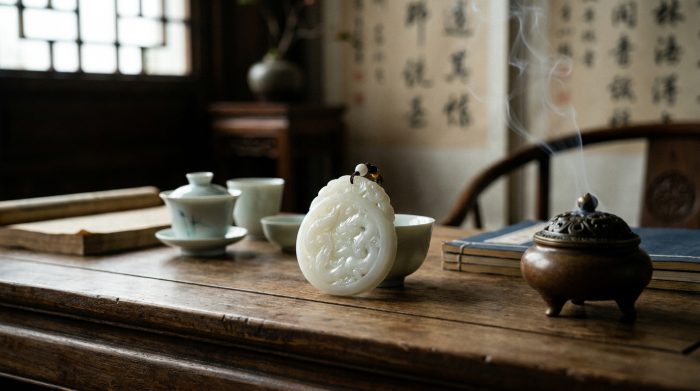
To carve jade is to accept a fundamental paradox: you must overcome one of nature's toughest materials using nothing but patience, skill, and understanding. Relief carving makes designs stand out with imposing layers. The masters of jade carving have developed over thousands of years a body of technique and philosophy that is as much spiritual practice as craft.
The Core Techniques of Jade Carving
Jade cannot be carved with ordinary tools — it is harder than most metals and tougher than granite. Jade workers use abrasive techniques: harder materials (originally quartz sand, later corundum and diamond) are used with rotating wheels, drills, and saws to grind away the stone. The major carving techniques include: Relief carving (浮雕 fúdiāo) — designs raised above the background surface, ranging from shallow bas-relief to high relief; Round carving (圆雕 yuándiāo) — fully three-dimensional sculptures worked from all sides; Openwork carving (镂雕 lòudiāo) — pierced designs where material is removed to create negative spaces, allowing light to play through; Qiaose carving (俏色 qiàosè) — using different color zones within a single piece of jade to create pictorial effects, requiring both technical skill and artistic vision. Each technique demands years of specialized training and a deep understanding of jade's physical behavior under abrasive pressure.
The Philosophy of 'Listening to the Stone'
Great jade carving is not about imposing a design on material — it is about discovering the design already present in the stone. The classical principle of suicai shishi (随材施艺, 'apply artistry according to the material') instructs carvers to respond to the jade's natural shape, color, inclusions, and veining rather than fighting against them. What appears to be a flaw in the raw stone — a color inclusion, a crack, an irregular shape — becomes an opportunity in the hands of a master. Famous examples: a carver who turned a blood-red inclusion in white jade into a fish-weir in a river scene; another who used a brown skin zone on seed jade to create autumn leaves on a crane's wings. This responsive approach is called 'following the material, applying the art' — and it requires both technical mastery and genuine artistic vision.
Recognizing and Appreciating Fine Jade Carving
For collectors, understanding jade carving quality begins with recognizing several key elements. Surface quality: fine carving shows clean, precise lines with no tool marks, chatter, or roughness; transitions between planes are smooth. Design quality: the best carving shows compositional balance, narrative clarity, and appropriate use of the jade's natural features. Technical difficulty: openwork carving, very thin walls, and fine hair-line engraving (游丝毛雕 yóusī máodiāo) represent the highest technical achievements. Material use: how intelligently has the carver used the jade's natural color, shape, and features? A master makes the stone feel inevitable — as if it couldn't have become anything other than what it now is. At Safinite, we select only pieces with genuine carving quality. Explore our carved jade collection or learn more at our jade art library.
Frequently Asked Questions
How long does it take to carve a jade piece?
Carving time varies enormously with complexity and size. A simple jade pendant might take a skilled carver 2-5 days. A medium-complexity figural carving (a small Buddha or dragon) might take 2-4 weeks. A complex showpiece with openwork carving, multiple figures, and fine surface detail might take 6-12 months. The most ambitious historical jade carvings — like the 'Yu the Great' monument commissioned by Emperor Qianlong — took years and required teams of carvers. Even with modern diamond tools, jade carving is fundamentally slow work; jade's toughness cannot be rushed.
What is the 'Han eight cuts' (汉八刀) technique?
Han eight cuts (汉八刀) is a distinctive carving style developed in the Han dynasty, characterized by minimal, decisive incision lines — as few as eight strokes might define an entire human or animal figure. The style is valued for its combination of economy and expressiveness: the lines are sharp, powerful, and placed with absolute precision. Han jade cicadas (used in burial rites) are the most famous examples of this style — a cicada's entire form suggested by just a few decisive grooves. The style has been revived by modern carvers who value its austere, graphic power.
The art of jade carving represents one of humanity's most sustained dialogues with natural beauty — a 8,000-year conversation between human creativity and geological wonder. At Safinite, every carved piece reflects this tradition. Explore our carved jade collection or visit the carving arts library.