
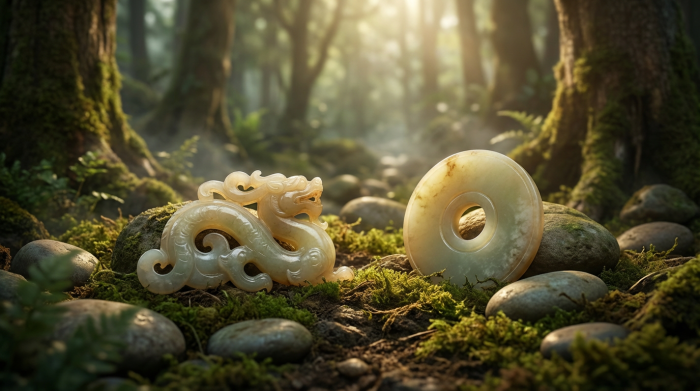
The art of jade carving is one of the world's most demanding and ancient crafts — a dialogue between human intention and nature's hardest gifts. The art of pierced and openwork carving is captivating and mesmerizing. For over eight thousand years, jade carvers have worked to reveal the beauty hidden within stone, developing techniques and traditions of extraordinary sophistication.
The Core Techniques of Jade Carving
Jade cannot be carved with ordinary tools — it is harder than most metals and tougher than granite. Jade workers use abrasive techniques: harder materials (originally quartz sand, later corundum and diamond) are used with rotating wheels, drills, and saws to grind away the stone. The major carving techniques include: Relief carving (浮雕 fúdiāo) — designs raised above the background surface, ranging from shallow bas-relief to high relief; Round carving (圆雕 yuándiāo) — fully three-dimensional sculptures worked from all sides; Openwork carving (镂雕 lòudiāo) — pierced designs where material is removed to create negative spaces, allowing light to play through; Qiaose carving (俏色 qiàosè) — using different color zones within a single piece of jade to create pictorial effects, requiring both technical skill and artistic vision. Each technique demands years of specialized training and a deep understanding of jade's physical behavior under abrasive pressure.
The Philosophy of 'Listening to the Stone'
Great jade carving is not about imposing a design on material — it is about discovering the design already present in the stone. The classical principle of suicai shishi (随材施艺, 'apply artistry according to the material') instructs carvers to respond to the jade's natural shape, color, inclusions, and veining rather than fighting against them. What appears to be a flaw in the raw stone — a color inclusion, a crack, an irregular shape — becomes an opportunity in the hands of a master. Famous examples: a carver who turned a blood-red inclusion in white jade into a fish-weir in a river scene; another who used a brown skin zone on seed jade to create autumn leaves on a crane's wings. This responsive approach is called 'following the material, applying the art' — and it requires both technical mastery and genuine artistic vision.
Recognizing and Appreciating Fine Jade Carving
For collectors, understanding jade carving quality begins with recognizing several key elements. Surface quality: fine carving shows clean, precise lines with no tool marks, chatter, or roughness; transitions between planes are smooth. Design quality: the best carving shows compositional balance, narrative clarity, and appropriate use of the jade's natural features. Technical difficulty: openwork carving, very thin walls, and fine hair-line engraving (游丝毛雕 yóusī máodiāo) represent the highest technical achievements. Material use: how intelligently has the carver used the jade's natural color, shape, and features? A master makes the stone feel inevitable — as if it couldn't have become anything other than what it now is. At Safinite, we select only pieces with genuine carving quality. Explore our carved jade collection or learn more at our jade art library.
Frequently Asked Questions
What tools are used to carve jade?
Modern jade carving uses diamond-tipped rotary tools powered by electric motors — diamond is hard enough to abrade jade. Tools include rotary saws for initial cutting, grinding wheels of various shapes for removing bulk material, smaller burrs and abrasive bits for detailed work, and increasingly fine abrasives for finishing and polishing. The basic principle hasn't changed in thousands of years — abrasive harder than jade removes material — but the tools have become far more precise and controllable. Traditional carvers used quartz sand, water, and bamboo or stone implements.
What is qiaose (俏色) carving and why is it so prized?
Qiaose (俏色) carving is the technique of using a jade stone's natural color variations as part of the design — incorporating different colored zones to create pictorial or symbolic effects. A master qiaose carver might use a red inclusion to create a poppy, a brown skin zone to suggest autumn leaves, or a grey zone to depict clouds. This technique requires both technical skill (working around inclusions without fracturing the stone) and genuine artistic vision (seeing the potential picture in the raw material). The best qiaose pieces appear to have been designed by nature and merely revealed by the carver.
The art of jade carving represents one of humanity's most sustained dialogues with natural beauty — a 8,000-year conversation between human creativity and geological wonder. At Safinite, every carved piece reflects this tradition. Explore our carved jade collection or visit the carving arts library.