
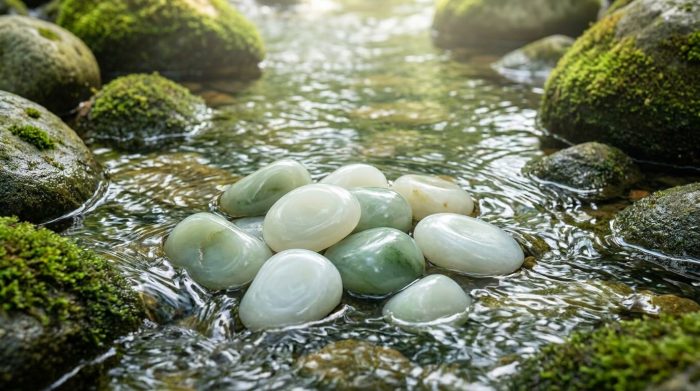
The Five Virtues of Jade (玉之五德) represent one of the most elegant systems of philosophical thought in human history — a complete ethical framework drawn from the physical qualities of a single stone. It means having a noble spirit that shows moral integrity, and being brave and responsible. This extraordinary synthesis of material perception and moral philosophy is distinctly Chinese and at least 2,500 years old.
The Five Virtues Explained
The Five Virtues of Jade were systematized by Han dynasty scholar Xu Shen (许慎) in his dictionary Shuowen Jiezi (121 CE), building on earlier philosophical discussions by Confucius, Guanzi, and Xunzi. The virtues are: Benevolence (仁 rén) — Jade's warm, smooth luster is like kindness that embraces the world, giving warmth without demanding anything in return. Righteousness (义 yì) — Jade's beauty is genuine inside and out, reflecting integrity that is consistent in all circumstances. Wisdom (智 zhì) — Jade's dense, fine texture produces a clear, resonant sound when struck, symbolizing the clear discernment of the wise person. Courage (勇 yǒng) — Jade is tough and resilient; it will shatter rather than bend, symbolizing the courage to maintain principles even at great personal cost. Purity (洁 jié) — Jade's unblemished quality and natural flaw-minimizing character symbolize moral purity and the commitment to correct conduct.
How the Virtues Were Perceived in Physical Properties
The genius of the Five Virtues framework is that it is grounded in genuine, observable physical properties of jade — not arbitrary associations. Jade's warmth (Benevolence): nephrite jade genuinely warms quickly against skin and holds heat in a distinctive way unlike cold stone. Jade's inside-outside consistency (Righteousness): what jade looks like on the surface reflects what it is throughout — there is no deceiving outer coating. Jade's clear tone (Wisdom): when struck, quality jade produces a clear, carrying sound — exactly the sound-before-fog metaphor for wisdom. Jade's fracture before bending (Courage): nephrite jade is tough but will shatter rather than deform plastically — it 'breaks cleanly' under ultimate stress. Jade's natural purity (Purity): the finest jade has minimal inclusions, reflecting the natural tendency toward clarity. These are real properties, not invented connections.
Living the Five Virtues Through Jade
The Five Virtues are not merely academic philosophy — they are a practical framework for how jade should be experienced and how it can serve self-cultivation. When you hold jade and feel its warmth, you can consciously reflect on benevolence — what acts of warmth and kindness have you extended today? When you examine jade and see that its surface beauty matches its inner substance, you can reflect on your own consistency between your public face and private character. When you hear jade's clear tone, you can think about the clarity of your own judgment. This practice of using jade as a reflective prompt — a material Rorschach for moral self-examination — is genuinely transformative if practiced consistently. At Safinite, we believe authentic Hetian jade is the ideal material for this practice: its physical qualities are genuine, its cultural depth is unmatched. Browse our collection or explore the Five Virtues library.
Frequently Asked Questions
Why are there five virtues specifically — where does the number come from?
The number five in Chinese philosophy is highly significant — it corresponds to the Five Elements (wood, fire, earth, metal, water), the Five Cardinal Relationships, the Five Directions (including center), and the Five Tones. Having five virtues places jade within this comprehensive cosmic framework. Earlier philosophical texts (Confucius, Guanzi) described different numbers of jade virtues (nine, seven, five) before the canonical five were established by Han dynasty scholars as the standard formulation.
What is the difference between jade's five virtues and the Confucian five relationships?
The Confucian Five Relationships (五伦, wǔlún) describe proper human social bonds: ruler-minister, parent-child, husband-wife, elder-younger sibling, friend-friend. Jade's Five Virtues (五德, wǔdé) describe moral qualities: benevolence, righteousness, wisdom, courage, purity. They are related but distinct systems. The Five Virtues of Jade were seen as the material embodiment of the virtues needed to fulfill the Five Relationships properly — you need benevolence for parent-child bonds, righteousness for ruler-minister relations, wisdom for friendship, and so on.
The Five Virtues of Jade offer timeless guidance for living well — wisdom drawn from one of nature's most extraordinary materials and two and a half millennia of philosophical reflection. At Safinite, we offer certified authentic Hetian jade that embodies these virtues in material form. Explore our collection or deepen your understanding at our philosophy library.