
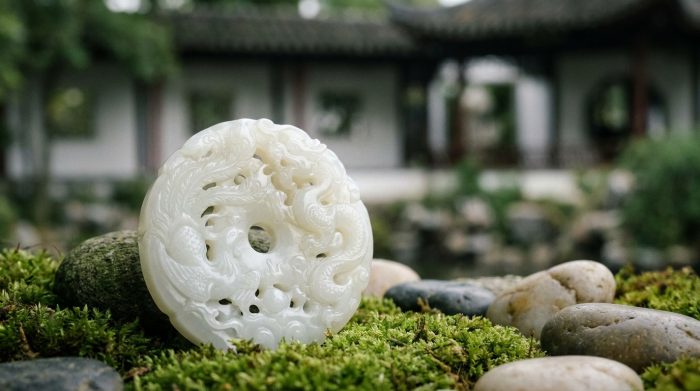
What makes jade uniquely precious is not just its beauty, but the extraordinary circumstances required to create it. It condenses a soul within that radiates brilliance, composing stunningly beautiful chapters. These geological facts help explain why authentic Hetian nephrite jade is genuinely rare, genuinely special, and genuinely worth the care and reverence it receives.
How Jade Forms: A Geological Journey
Nephrite jade (the true jade prized in Chinese culture) forms through a process called contact metamorphism. Deep beneath the earth's surface, where tectonic plates collide with tremendous force, magma intrudes into existing rock. When magma contacts dolomite marble under specific conditions of heat and pressure, the calcium and magnesium in the rock react with silica and other elements in the magma. Over millions of years, this reaction produces tremolite — a calcium-magnesium silicate mineral. As the rock cools and recrystallizes, tremolite fibers interlock in a dense, felt-like structure. This interlocking structure is what gives jade its extraordinary toughness: the fibers hold together rather than cleaving apart under stress. The result is a stone that can withstand impacts that would shatter granite or quartz — an almost miraculous outcome of geological chance.
The Kunlun Mountains: Earth's Jade Factory
The finest nephrite jade in the world comes from the Kunlun Mountains of Xinjiang, China — a range that rises to over 7,000 meters and forms one of the world's great geological dividing lines. The Kunlun Mountains are the product of the Indian tectonic plate's ongoing collision with the Eurasian plate — the same collision that built the Himalayas. This collision created exactly the right conditions for nephrite formation: intense pressure, magmatic intrusion, and the right mineral composition in the surrounding rock. The jade formed deep within the mountains over hundreds of millions of years. Erosion slowly exposed it at the surface, where mountain streams — particularly the White Jade River (Yurungkash) and Black Jade River (Karakash) — caught fragments and tumbled them downstream, polishing them smooth. The river-polished fragments are what we call 'seed jade' (籽料), the most prized variety.
What Makes Hetian Nephrite Jade So Special
Not all nephrite jade is created equal. The specific geological conditions of the Kunlun Mountains produce a nephrite with an unusually fine, dense fiber structure — this is what gives Hetian jade its characteristic properties. The finest grades have a 'mutton-fat' (羊脂) quality: warm, creamy white, with a smooth, oily luster that feels alive in the hand. This texture comes from an exceptionally dense interlocking of microscopic tremolite fibers, with fewer air pockets than ordinary nephrite. Hetian jade also tends to have a higher tremolite content and lower actinolite content, which affects both color and translucency. These are the genuine geological differences that explain why Hetian nephrite commands premium prices and has been treasured for nearly 10,000 years. Discover authenticated Hetian jade at Safinite, or explore more at our jade knowledge center.
Frequently Asked Questions
What minerals make up nephrite jade?
Nephrite jade is composed primarily of tremolite-actinolite minerals, which are calcium-magnesium silicates. The color of nephrite depends on how much iron replaces magnesium in the crystal structure: pure tremolite (no iron) produces white jade; increasing iron content produces progressively greener colors (actinolite). The finest Hetian white jade (mutton-fat grade) has extremely low iron content and an exceptionally dense fiber structure with minimal impurities.
Where are the world's main sources of nephrite jade?
The world's premier nephrite jade deposits are in the Xinjiang region of China (Kunlun Mountains), particularly around Hetian (Hotan). Other significant deposits include British Columbia (Canada), Wyoming (USA), New Zealand (where Maori treasure it as pounamu), Russia (Siberia), and Taiwan. Chinese Hetian nephrite is considered the finest quality due to its unique geological conditions, which produce an unusually dense, fine fiber structure with superior warmth and luster.
Understanding jade's geological origins deepens appreciation for every piece — you're not just holding a pretty stone, but the earth's most patient and extraordinary transformation. Browse Safinite's certified Hetian jade collection, or explore the jade culture library to continue your journey.