
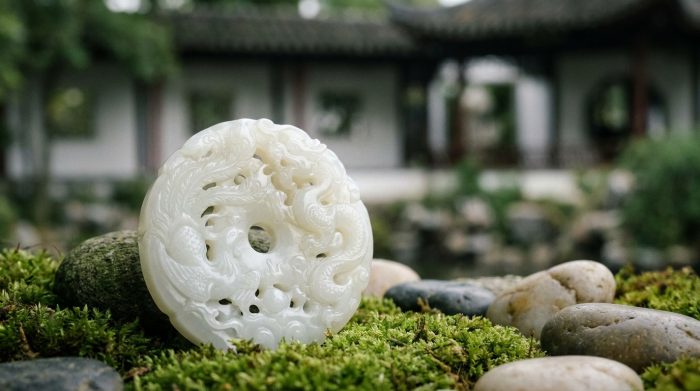
The relationship between jade and the Chinese language is profound — jade has shaped how Chinese people think and speak about beauty, virtue, and value for three thousand years. Jade person (praise for beauty); jade pen (fine writing tool); jade burial suit. Understanding jade's linguistic legacy illuminates an essential dimension of Chinese cultural identity.
The Jade Radical: Building Beauty into the Language
The Chinese character for jade (玉, yù) is one of the most productive components in the entire writing system. As a radical — a character used as a building block for other characters — the jade component (written 王 on the left side of compound characters) appears in hundreds of words related to beauty, preciousness, and value. Characters formed with the jade radical include: 珍 (zhēn, precious), 玲 (líng, clear sound), 珀 (pò, amber), 璃 (lí, glass), 璞 (pú, uncut jade), 玺 (xǐ, imperial seal), 瑰 (guī, magnificent), 琢 (zhuó, to carve). Even words for many other gems — pearl (珠 zhū), coral (珊珊 shānshān with altered character), and agate (玛瑙 mǎnǎo) — use characters related to jade. This systematic embedding of jade's qualities into the language reflects how deeply jade values shaped Chinese conceptual vocabulary.
Jade Idioms: A Treasury of Cultural Wisdom
Chinese four-character idioms (成语 chéngyǔ) are concentrated packages of cultural wisdom, often derived from historical events or classical literature. Jade appears in hundreds of idioms. 'Returning the jade intact to Zhao' (完璧归赵 wán bì guī Zhào) — from the story of diplomat Lin Xiangru who safely returned the precious He's Jade to the state of Zhao — means completing a task with integrity, returning something intact. 'Like cutting and grinding jade' (如切如磋, rú qiē rú cuō) — from the Book of Odes — describes diligent self-improvement through sustained effort. 'Gold and jade on the outside, rot within' (金玉其外,败絮其中) warns against superficiality. 'Gold words, jade speech' (金玉良言) means precious, trustworthy advice. These idioms carry jade's qualities into everyday speech, making the values of jade part of daily moral discourse.
Jade in Poetry and Literary Culture
Jade pervades classical Chinese poetry as both subject and metaphor. In the great Tang poetry anthology, jade appears in descriptions of a woman's skin ('jade skin'), beauty ('jade-like'), a handsome man ('jade tree in the wind'), the moon ('jade disc'), and palace halls ('jade halls'). Su Dongpo, one of China's greatest poets, wrote about specific jade pieces with the attentiveness other poets give to flowers or moonlight. Li Bai compared his beloved's fingers to jade shoots. The Tang imperial palace was often called 'jade halls and gold palaces.' This poetic tradition embedded jade's qualities — warmth, purity, luster, endurance — into the language's most beautiful expressions, so that jade became a shorthand for the best qualities of beauty, virtue, and value. Explore more jade language and culture at Safinite's jade library, or find beautiful authentic jade at our collection.
Frequently Asked Questions
What does '宁为玉碎,不为瓦全' mean?
This idiom means 'Better to be shattered jade than unbroken clay.' It expresses the willingness to die with honor rather than survive with shame — to sacrifice everything rather than compromise one's principles. The contrast is powerful: jade is precious, beautiful, and precious even in fragments; clay (ordinary ceramic) is common and its wholeness has little value. The idiom is attributed to Yuan Jingzhong (6th century CE) and remains a powerful expression of integrity and moral courage in modern Chinese.
How is jade connected to the idea of a 'perfect gentleman' in Chinese language?
The Chinese word for 'gentleman' or 'person of noble character' (君子, jūnzǐ) is frequently associated with jade in classical texts. Confucius said 'A gentleman, for no reason, should not be without his jade.' The classical text Baihu Tongyi states: 'Why does a gentleman value jade? Because jade is like virtue.' In modern Chinese, a person of refined character and dignity is sometimes called a 'jade person' (玉人), and the concept of using jade as a standard for personal virtue remains alive in Chinese moral vocabulary.
Jade's imprint on Chinese language — in characters, idioms, poetry, and philosophy — reveals the depth of its cultural significance. To understand jade is to understand something essential about Chinese civilization. Explore our jade language and culture center, or find your piece of this living tradition in our authenticated collection.