
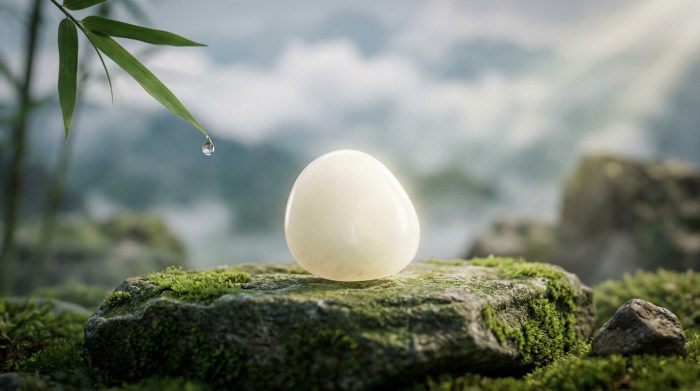
In Confucian philosophy, the highest aspiration of human life is not wealth or power, but virtue — the cultivation of moral excellence that makes a person genuinely good, and genuinely good to be around. Two and a half thousand years ago, Chinese philosophers discovered that jade could serve as a perfect teacher of virtue: its physical properties correspond, with uncanny precision, to the moral qualities a person should develop. The result was the Five Virtues of Jade (玉之五德) — one of the most elegant philosophical systems ever created.
What Are the Five Virtues of Jade?
The Five Virtues were systematized by Han dynasty lexicographer Xu Shen (许慎) in his landmark dictionary Shuowen Jiezi (121 CE), building on earlier discussions by Confucius, Guanzi, and Xunzi. They are: Benevolence (仁 rén), Righteousness (义 yì), Wisdom (智 zhì), Courage (勇 yǒng), and Purity (洁 jié). Each virtue corresponds to a specific, observable physical quality of jade — this is not arbitrary association, but genuine philosophical perception that saw moral meaning in natural properties.
Virtue 1: Benevolence (仁) — Warm, Smooth Luster
Jade's first virtue is benevolence — the warmth and inclusive kindness that is the foundation of all Confucian ethics. In jade, this virtue is expressed through the stone's characteristic warmth and smooth luster. Unlike cold stone, fine nephrite jade warms quickly against the skin and seems to hold that warmth with particular intimacy. Its luster is not the cold brilliance of crystal or diamond, but a warm, diffuse glow — like light through fat — that seems to come from within rather than reflect from without. Confucian philosophers saw in this warmth an analogy for benevolent people: they extend warmth without demanding anything in return, they illuminate their surroundings without harsh edges, they embrace others with quiet steadiness. The practice of feeling jade's warmth in the hand was a daily reminder to cultivate the same quality in oneself.
Virtue 2: Righteousness (义) — Beauty Inside and Out
Jade's second virtue is righteousness — integrity that is consistent between private character and public conduct. In jade, this is expressed by the stone's physical consistency: what jade looks like on the surface accurately reflects what it is throughout. Unlike materials with decorative coatings or surface treatments, authentic jade (particularly nephrite) has the same quality and composition from exterior to core. There is no beautiful surface hiding a degraded interior. Confucian philosophers saw in this consistency the emblem of a righteous person: one whose public face matches their private character, whose stated values correspond to their actual behavior. This is why jade authentication still matters so deeply — a treated or artificial jade is, philosophically speaking, unrighteous.
Virtue 3: Wisdom (智) — Dense Texture, Clear Sound
Jade's third virtue is wisdom — the capacity for clear discernment and meticulous thought. In jade, this is expressed in two related properties: the stone's unusually dense, fine fiber structure, and the clear, resonant tone it produces when struck. The density reflects careful, thorough organization at the molecular level — nothing wasted, nothing superficial. The sound — a clear, carrying bell-tone that Confucian texts describe as 'golden sound, jade chime' (金声玉振) — arises from this density and travels far without distortion. Philosophers saw in these properties the qualities of genuine wisdom: dense with real understanding rather than hollow with pretension, producing clear signal rather than confused noise. The practice of listening to jade's tone — and comparing stones by their sound quality — was a cultivation of discernment that carried moral as well as aesthetic dimensions.
Virtue 4: Courage (勇) — Tough, Shatters Rather Than Bends
Jade's fourth virtue is courage — the tenacity to maintain principles even under extreme pressure, and the willingness to break rather than compromise. Nephrite jade is extraordinary in its physical toughness — its interlocking fiber structure makes it more impact-resistant than most metals. Yet under ultimate stress, it fractures cleanly rather than deforming gradually. It does not bend, warp, or compromise its structure to accommodate pressure. Confucian philosophers saw in this property the emblem of the courageous person: tough enough to resist ordinary pressures without yielding, yet when faced with impossible demands, choosing honorable failure over shameful compliance. The Chinese idiom 宁为玉碎,不为瓦全 ('Better to be shattered jade than unbroken clay') captures this precisely: jade's courage is the courage of principle over survival.
Virtue 5: Purity (洁) — Unblemished Quality
Jade's fifth virtue is purity — the commitment to moral correctness that keeps character unblemished. In jade, this is expressed in the stone's natural tendency toward minimal inclusions and impurities in its finest grades. The best Hetian nephrite — 'mutton-fat' grade — approaches genuine purity: creamy white, virtually free of visible inclusions or discoloration, with a quality that seems to come from the stone's own nature rather than from any external intervention. Confucian philosophers saw in this natural purity the model for moral cleanliness: not a purity achieved by hiding imperfections, but a natural integrity that comes from consistent right action. The standard for jade's purity was high — and the standard for human purity was equally high.
How to Use the Five Virtues as a Daily Practice
The Five Virtues were not meant to be merely academic — they were designed as a practical framework for daily self-cultivation. The practice is simple: wear or carry genuine jade, and when you feel it, see it, or hear it, let each physical property prompt moral reflection. Feel jade's warmth: have you been as generous and warm to others today as this stone is to your hand? Observe jade's consistency: have your private actions today matched your public values? Listen to jade's tone: have your judgments today been clear and fair, or clouded by emotion and preference? Note jade's resilience: have you maintained your principles under pressure, or bent them for convenience? See jade's purity: have you kept your commitments and your integrity clean? This mindfulness practice, embedded in a beautiful physical object, is one of the most elegant self-improvement systems ever designed.
Frequently Asked Questions
Who first described the Five Virtues of Jade?
The Five Virtues were discussed by several Confucian thinkers. Confucius himself made statements about jade's moral qualities (recorded in the Book of Rites). Guanzi (7th century BCE) described nine virtues in jade. Xunzi (3rd century BCE) described seven. The canonical Five Virtues were systematized by Xu Shen in his Shuowen Jiezi dictionary (121 CE), which became the authoritative formulation for subsequent Chinese jade philosophy.
Why does jade specifically represent these five virtues — why not other materials?
The Five Virtues were identified in jade because jade's specific physical properties genuinely correspond to the moral qualities described. Jade really is warm and luminous (Benevolence); it really is consistent inside and out (Righteousness); it really does produce a clear, resonant sound (Wisdom); it really does fracture rather than bend (Courage); and the finest jade really does have minimal impurities (Purity). The Confucian thinkers were not inventing arbitrary associations — they were reading genuine moral meaning from genuine physical facts about an extraordinary material.
Can I practice the Five Virtues philosophy with any jade, or does it need to be Hetian nephrite?
Confucian jade philosophy developed in a context where nephrite (particularly Hetian nephrite) was the premier jade material. The physical properties that correspond to the Five Virtues — warmth, internal consistency, clear tone, toughness, natural purity — are most authentically present in genuine Hetian nephrite. While any genuine jade can serve as a focus for philosophical reflection, the depth of the practice is greatest with authentic material whose physical properties genuinely embody the virtues described. All pieces in Safinite's collection are certified authentic Hetian nephrite.
Is the Five Virtues framework still relevant today?
Absolutely. The Five Virtues — benevolence, righteousness, wisdom, courage, purity — are timeless ethical aspirations. Using jade as a physical reminder of these virtues is a practical mindfulness technique that works in any culture and era. Many people who are new to Chinese jade culture find that the Five Virtues framework gives their jade a depth of meaning that transforms it from jewelry to something genuinely meaningful — a daily companion in the cultivation of character.
The Five Virtues of Jade are more than historical philosophy — they are a living practice that continues to give jade its deepest meaning. To hold a piece of certified authentic Hetian jade is to hold one of the world's most thoughtfully understood materials: a stone whose physical properties have been read, for 2,500 years, as a moral education. Explore the full jade culture library at Safinite, or browse our collection of authenticated Hetian jade pieces to find the jade that will accompany your own practice of virtue.