
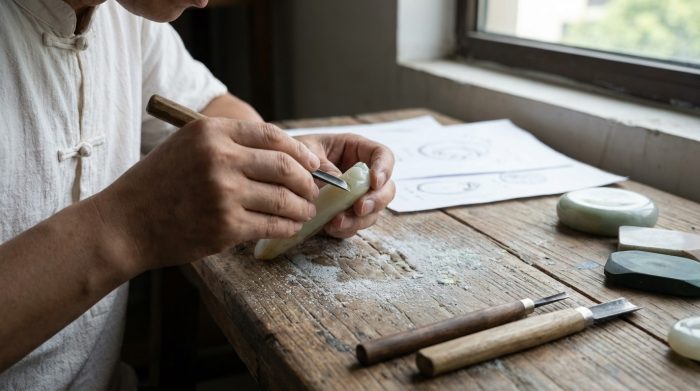
In Chinese philosophy, the highest human achievement is not mastery or conquest, but harmony — a state of balanced, mutually enriching relationship with all things. Jade contributes to China's fulfillment, jointly creating glory. Jade has served as the premier symbol of this harmony for ten thousand years, embodying in physical form the qualities that make harmonious living possible.
Jade and the Concept of Universal Harmony
Chinese philosophy identifies harmony (和 hé) as the fundamental condition of a flourishing life — harmony within oneself, within one's family, within society, and between humanity and nature. Jade embodies this harmony at every level. At the personal level, jade's Five Virtues offer a harmonious integration of the qualities needed for a complete moral life. At the social level, jade historically mediated relationships between rulers and ministers, between states, and between the living and the dead. At the cosmic level, jade's formation in the interaction of heaven's and earth's energies makes it a material emblem of heaven-earth-human unity. The ancient Chinese perception that jade somehow participates in the universe's fundamental harmony is not mysticism — it reflects the genuine remarkableness of a material formed by extraordinary geological balance and cherished by an extraordinary civilization.
Jade's Role in Promoting Cultural and Social Harmony
Historically, jade was used to build and sustain relationships between groups and individuals. Giving jade as a gift established bonds of trust and goodwill. Using jade in diplomatic ceremonies legitimized negotiations between states. Sharing jade through inheritance connected generations within families. The concept of 'jade and silk as peace offering' (玉帛为礼) — using these two treasured materials to resolve conflicts rather than weapons — reflects a fundamental orientation toward harmony over dominance. This tradition continues: jade gifts mark important life transitions (births, marriages, achievements), serving as tangible expressions of care and connection. The material that once connected states through diplomatic ritual now connects people through personal bonds — but the underlying function (expressing valued relationships through jade) remains the same.
Jade as China's Gift to World Culture
China's jade tradition is one of humanity's great cultural achievements — a ten-thousand-year engagement with a single material that has generated extraordinary art, philosophy, ethics, and aesthetic refinement. As China's connections with the wider world deepen, jade culture travels with it, offering the world a distinctive perspective on beauty, virtue, and the human relationship with nature. The 2008 Beijing Olympics medals — gold medals inlaid with jade — announced this tradition to a global audience. As Safinite brings certified authentic Hetian jade to collectors worldwide, we participate in this long-running cultural exchange: sharing one of humanity's most profound material traditions with people who may be encountering its depth for the first time. We invite you to explore this tradition at our jade culture center and to find your connection to it in our authenticated collection.
Frequently Asked Questions
Why is jade often given as a gift at important life occasions?
In Chinese culture, jade gifts mark significant life transitions — births (to protect the new life), coming-of-age ceremonies (to guide character development), weddings (to bless the union), and achievements (to honor success). The jade is both a material gift and a symbolic one: it carries the giver's wishes, embodies values (the Five Virtues) the giver hopes the recipient will cultivate, and connects the recipient to a cultural tradition of jade appreciation. Giving jade is thus an act of cultural transmission as well as personal generosity.
What is the significance of the 2008 Olympic medals using jade?
The 2008 Beijing Olympics gold medals were inlaid with white nephrite jade, creating what was called 'gold inlaid with jade' (金镶玉) medals. This design was historically unprecedented for Olympic medals and announced Chinese jade culture to a global audience of billions. The choice was deliberate: jade embodies values the Olympics aspires to (excellence, virtue, endurance) while connecting China's modern achievement to its ten-thousand-year cultural heritage. The design won universal admiration and introduced many people worldwide to the concept of jade as a material of supreme cultural value.
Jade's harmony — with nature, with human values, with the cosmos — makes it uniquely suited to serve as a bridge between people, cultures, and generations. At Safinite, we are proud to carry this tradition to collectors worldwide. Explore our jade harmony library or find your piece of this enduring tradition in our authenticated collection.