
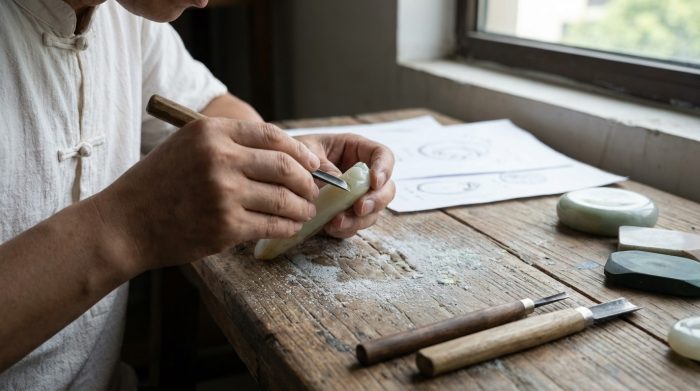
Jade carving presents a fundamental paradox: you must overcome one of nature's toughest materials using nothing but patience, skill, and understanding. Nephrite jade cannot be carved with ordinary tools — it is harder and tougher than most metals. Yet for eight thousand years, jade artisans have transformed this intractable material into objects of extraordinary beauty, developing in the process a body of technique and philosophical approach unlike any other carving tradition.
The Foundational Principle: Following the Stone
Before examining specific techniques, the governing philosophy of jade carving must be understood: suicai shishi (随材施艺, 'apply artistry according to the material'). This principle holds that the carver's primary task is not to impose a design on jade, but to discover the design already present in the stone — responding to its natural shape, color zones, inclusions, and veining. A flaw that would be discarded in other materials becomes, in skilled hands, a design element: a rust-red inclusion becomes a burning torch; a grey zone becomes storm clouds; an irregular shape suggests a mountain rather than fighting it. This responsive philosophy is not just practical adaptation — it reflects a deeper Taoist insight that the best human work harmonizes with natural processes rather than overriding them.
Relief Carving (浮雕 Fúdiāo): Layers That Create Depth
Relief carving is the technique of raising designs above a background surface — the background is cut away, leaving the design elements standing in relief. Bas-relief (shallow relief) creates subtle, painterly effects where designs stand only slightly above the surface. High relief creates dramatic three-dimensional effects where figures may extend significantly above the background plane. The technical challenge in jade relief carving is controlling depth precisely across an entire composition: cut too shallow and the design lacks presence; cut too deep and you risk fracturing the jade or creating visual confusion. Relief carving is the dominant technique in jade plaques, pendants with pictorial designs, and decorative panels. Its effectiveness depends heavily on the relationship between positive (raised) and negative (recessed) elements — the spaces between design elements are as important as the elements themselves.
Round Carving (圆雕 Yuándiāo): Complete Three-Dimensional Sculpture
Round carving produces fully three-dimensional objects worked from all sides — sculptures in the round. This technique allows the carver to create pieces that read from any angle, where every view reveals different aspects of the design. Figures (Buddha statues, animals, mountain scenes), vessels (bowls, cups, containers), and decorative objects are typically executed in round carving. The technical challenges are substantial: maintaining structural integrity while removing material from all sides; planning the removal sequence to avoid fracturing thin sections before they are fully supported; and ensuring the final form is balanced — visually, and sometimes literally. The finest round-carved jade shows no evidence of the technical difficulties involved: surfaces flow naturally, proportions are balanced, and the piece seems to have emerged from the stone as naturally as a creature from an egg.
Openwork Carving (镂雕 Lòudiāo): Light as Design Element
Openwork or pierced carving removes material through and through, creating negative spaces that become part of the design. Light passes through the openings, creating effects of transparency, depth, and visual lightness impossible in solid carving. The technical demands of openwork are the highest in jade carving: structural integrity must be maintained while removing material that would in other techniques provide support. Thin bridges of jade must connect design elements; these bridges must be strong enough to survive the carving process and subsequent handling, yet light enough not to disrupt the design's visual flow. Some of the most extraordinary jade openwork produces pierced designs so delicate that the jade seems to become lace — dozens of interlocking elements connected by bridges no thicker than a few millimeters. This technique is particularly prized in pendants and screens, where the interplay of light and stone creates effects that change with the angle of view.
Qiaose Carving (俏色 Qiàosè): Using Color as Design
Qiaose is perhaps the most distinctively Chinese of jade carving techniques. The word literally means 'taking advantage of color' — the technique uses the jade's natural color variations as part of the pictorial or symbolic design. A jade boulder with a red-brown inclusion might be carved so that the inclusion becomes an autumn maple leaf in a landscape scene. Seed jade's colored outer skin might be retained as the color of a squirrel's fur or a carp's scales against the white jade body below. The possibilities depend entirely on each specific piece of jade — no two pieces are the same, and no design can be planned in advance with certainty. Qiaose carving thus demands both technical mastery (working with inclusions rather than around them) and genuine artistic imagination (seeing the potential picture in raw material). The finest qiaose pieces seem preordained — as if nature itself designed the color pattern to tell this particular story.
Historical Style Evolution: Reading Dynasty in Technique
Jade carving styles have evolved significantly across Chinese history, and experienced collectors can often date a piece by its technique. Neolithic jades (Liangzhu, Hongshan) show fine geometric incision using abrasive tools. Shang dynasty jade introduced the three-dimensional animal sculpture tradition. Zhou dynasty developed the 'double-line squeeze ridge' (双线挤地) — two parallel incised lines creating a raised ridge between them, characteristic of dragon and scroll designs. Han dynasty's 'Eight Cuts' style (汉八刀) used minimal, powerful incisions to create maximum effect. Tang dynasty preferred flowing, rounded forms with polished surfaces. Song favored restrained, naturalistic designs. Ming master Lu Zigang pioneered fine figure-and-calligraphy plaques of extraordinary refinement. Qing imperial jades combined all techniques at maximum scale and technical perfection.
Frequently Asked Questions
How do modern jade carvers work — do they still use traditional tools?
Modern jade carvers use diamond-tipped rotary tools powered by electric motors — diamond is hard enough to abrade nephrite jade. The basic principle (abrasive harder than jade removes material) is unchanged from ancient times, but modern tools offer far greater precision and control. Some traditional hand techniques are maintained for specific effects — hand-held abrasive cords for certain linear cuts, for example. The finest jade carvers combine modern tool capabilities with traditional design sensibility, producing work that would not be possible with ancient tools alone.
What distinguishes good jade carving from average or poor carving?
Quality in jade carving can be assessed across several dimensions. Technical quality: clean, precise cuts with no tool marks or chatter; smooth surface treatment; even wall thickness in openwork. Design quality: compositional balance, narrative clarity, appropriate use of positive and negative space. Material use: intelligent use of the jade's natural color, shape, and features (qiaose application). Spiritual resonance: the best pieces have a quality that transcends technical execution — an inevitable rightness that suggests the design was always present in the stone. Learning to see these qualities takes time and exposure to many pieces across a range of quality levels.
What is 'yousi maodiao' carving and why is it rare?
Yousi maodiao (游丝毛雕, 'wandering silk hair engraving') is a technique of incising lines so fine they appear as hair threads on the jade surface — sometimes just 0.1-0.2mm wide. Traditional versions were created by rotating the jade against a stationary abrasive tool while the carver watched through magnification. The result is a surface covered with thousands of hair-fine curved lines that suggest organic textures (feathers, fur, fabric) without visible individual strokes. This technique requires absolute tool control, extraordinary patience, and years of specialized practice. Very few carvers today can execute it at historical standards.
How should I care for a carved jade piece to preserve the carving?
Carved jade should be cleaned gently with a soft brush and warm water — a soft toothbrush can reach into carved recesses without damaging them. Avoid ultrasonic cleaners (vibration can stress fine openwork). Avoid harsh chemicals. Store away from objects that could scratch the surface. For display, avoid direct strong sunlight which can fade some jade colors over time. Regular gentle handling (in the Chinese tradition of 'playing with jade') maintains luster naturally through skin oil contact. For valuable or historically significant pieces, consult a jade conservator before any cleaning.
Understanding jade carving techniques transforms your experience of carved pieces from passive admiration to active appreciation — you begin to see the decisions, challenges, and philosophy embedded in every cut. At Safinite, our carved jade pieces are selected for genuine carving quality as well as material excellence. Explore our carved jade collection, or visit our jade art library to continue your education in this extraordinary tradition.