
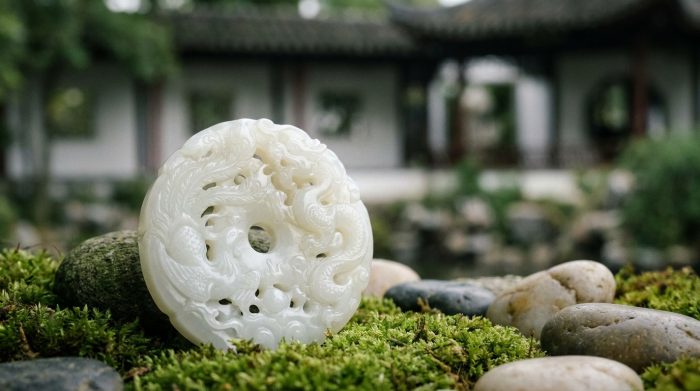
You don’t decide to love jade. It happens to you.
It might be in a museum, standing before a five-thousand-year-old jade dragon in a case, and feeling, without being able to explain why, that the object is looking back at you. It might be in a market, when a piece of warm green stone catches the light at exactly the right moment and something in you stops. It might be when you hold a piece of fine nephrite for the first time and feel its particular, inexplicable warmth — the way it seems to meet your hand rather than simply occupy it.
However it happens, once it does, you will spend the rest of your life learning. This guide is a beginning — not a destination.
Start With the Two Jades
The most important thing a beginner needs to know: “jade” refers to two completely different minerals, each with its own character, history, and aesthetic.
Nephrite is the jade of the ancient world — the jade of the Jade Road, of Neolithic cultures, of imperial ritual, of ten thousand years of Eastern civilization. Nephrite is prized for its warmth, its toughness, and a quality of light called wen run: warm and moist, as if the stone were almost alive. Its colors range from the prized “mutton-fat white” (a creamy, luminous white with an oily luster) through celadon and green to russet, brown, and black. Fine nephrite does not dazzle. It draws you in slowly. The more you look, the more you find.
Jadeite arrived in the Eastern tradition more recently, carried along ancient trade routes from the mountains of Myanmar. Jadeite is the jade of vivid color: its finest “Imperial Green” specimens achieve a saturated emerald that seems to pulse with inner light. Jadeite dazzles immediately — it does not wait for you to discover it. It announces itself. Its lavender, white, and bicolor varieties have their own extraordinary appeal. Fine jadeite is among the most valuable gem materials in the world.
Neither jade is superior to the other. They are different conversations about beauty.
What to Look For: The Four Qualities
Connoisseurs assess jade along four dimensions — a framework simple enough to learn and deep enough to spend a lifetime with:
- Color (Se): Purity, evenness, and depth. In nephrite, a pure, consistent color without patches is ideal. In jadeite, the distribution of color — whether it is evenly spread or creates interesting patterns — is a primary consideration. Color should feel alive, not flat.
- Transparency (Zhong): The Eastern ideal is semi-translucency — light enters the stone and diffuses within it, creating the quality called shui tou (water head): the sense of luminosity from within. Not glassy clarity, not opaque density, but a living middle state.
- Texture (Di): The fineness of the stone’s grain. Fine texture is smooth, dense, and even — like looking through very slightly frosted glass. Coarser texture shows visible crystalline structure. Texture affects both appearance and how the stone feels against the skin.
- Craftsmanship (Gong): In carved jade, how well has the carver worked with the natural qualities of the stone? The great principle applies: follow the material, apply the art. A piece where the design feels imposed on the stone is less accomplished than one where the design feels inevitable.
Trust Your Hands
The hand knows things the eye cannot. Hold a piece of genuine fine jade. It is cool at first touch. Then, within seconds, it warms — not merely absorbing your heat, but meeting it, finding an equilibrium that feels more like mutual recognition than simple thermal exchange. This quality cannot be faked by glass, plastic, or any synthetic material. When you feel it, you will know it immediately, even if you cannot explain why.
Fine jade also has a satisfying density — heavier than it looks, carrying a substance that imitations cannot replicate. When you tap two pieces of genuine nephrite together, they ring with a clear, resonant tone. The ancient tradition compared this to heavenly music. Once you’ve heard it, you understand why.
“The finest jade is like congealed fat — warm, luminous, softly radiant. It does not shout its beauty. It waits for you to be quiet enough to hear it.”
The Practice of Looking
The Eastern tradition teaches that the best way to develop an appreciation for jade is not to read about it, but to handle it. Carry a piece with you. Return to it through the day. Notice how your perception of it deepens over hours and weeks. Jade is a material that rewards sustained attention — each time you look, there is more to find.
Visit museums with serious jade collections. Sit in front of objects that are thousands of years old and let yourself be patient. The ancient craftspeople who made these things spent months, sometimes years, in conversation with each stone. They have earned the right to make us slow down.
Buy the piece that makes you feel something before you understand it. Understanding comes later — and when it does, it will only deepen what you already felt.
A Last Word
Jade is not a hobby. It is not a collection. It is — if you let it be — a relationship. With the stone, with the civilization that learned to love it, with the ten thousand years of human hands that have held it before yours.
The beauty of jade is real. The philosophy it carries is genuine. The warmth it seems to offer — that quality that has made people reach for the word “alive” to describe a mineral for fifty centuries — is something that you will have to decide for yourself, once the stone is in your hand.
I only suggest: give it a chance to show you. Be still. Be patient. Be open.
The jade has been waiting for ten million years. A few quiet minutes is the least we can offer.