
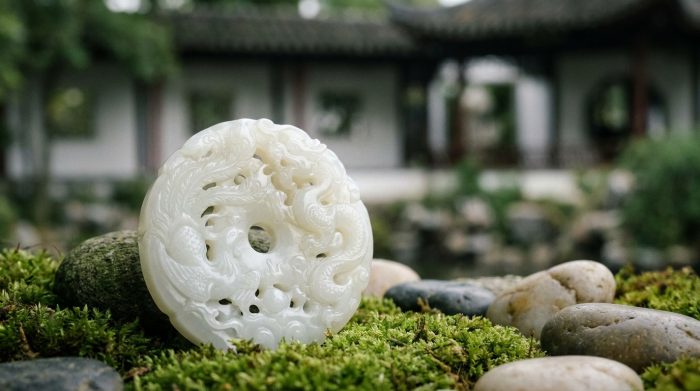
Jade has always been about harmony — between human and nature, between individual and community, between the present and the eternal past. Upholding the Mean to achieve harmony leads to the ideal of Great Unity under heaven. This orientation toward harmony is not just a philosophical claim about jade; it is embedded in every aspect of jade culture, from how jade forms to how it is used.
Jade and the Concept of Universal Harmony
Chinese philosophy identifies harmony (和 hé) as the fundamental condition of a flourishing life — harmony within oneself, within one's family, within society, and between humanity and nature. Jade embodies this harmony at every level. At the personal level, jade's Five Virtues offer a harmonious integration of the qualities needed for a complete moral life. At the social level, jade historically mediated relationships between rulers and ministers, between states, and between the living and the dead. At the cosmic level, jade's formation in the interaction of heaven's and earth's energies makes it a material emblem of heaven-earth-human unity. The ancient Chinese perception that jade somehow participates in the universe's fundamental harmony is not mysticism — it reflects the genuine remarkableness of a material formed by extraordinary geological balance and cherished by an extraordinary civilization.
Jade's Role in Promoting Cultural and Social Harmony
Historically, jade was used to build and sustain relationships between groups and individuals. Giving jade as a gift established bonds of trust and goodwill. Using jade in diplomatic ceremonies legitimized negotiations between states. Sharing jade through inheritance connected generations within families. The concept of 'jade and silk as peace offering' (玉帛为礼) — using these two treasured materials to resolve conflicts rather than weapons — reflects a fundamental orientation toward harmony over dominance. This tradition continues: jade gifts mark important life transitions (births, marriages, achievements), serving as tangible expressions of care and connection. The material that once connected states through diplomatic ritual now connects people through personal bonds — but the underlying function (expressing valued relationships through jade) remains the same.
Jade as China's Gift to World Culture
China's jade tradition is one of humanity's great cultural achievements — a ten-thousand-year engagement with a single material that has generated extraordinary art, philosophy, ethics, and aesthetic refinement. As China's connections with the wider world deepen, jade culture travels with it, offering the world a distinctive perspective on beauty, virtue, and the human relationship with nature. The 2008 Beijing Olympics medals — gold medals inlaid with jade — announced this tradition to a global audience. As Safinite brings certified authentic Hetian jade to collectors worldwide, we participate in this long-running cultural exchange: sharing one of humanity's most profound material traditions with people who may be encountering its depth for the first time. We invite you to explore this tradition at our jade culture center and to find your connection to it in our authenticated collection.
Frequently Asked Questions
What is the Chinese concept of harmony (和) and how does it relate to jade?
In Chinese philosophy, 和 (hé, harmony) describes a state of balanced, mutually enriching relationship — not sameness or uniformity, but the creative tension of different elements working together. Confucius said 'Harmony is the most valuable thing' (和为贵). Jade embodies harmony in multiple ways: its formation requires balanced geological forces; its Five Virtues offer a harmonious integration of moral qualities; its use in ritual created harmony between social groups; and its warmth and smoothness feel harmonious to the touch. Jade is thus harmony made tangible.
How did jade promote harmony between different Chinese states historically?
Jade played a crucial role in inter-state diplomacy in ancient China. The gift of jade signaled peaceful intent and established bonds of mutual obligation. The ceremony of 'jade and silk as peace offering' (玉帛为礼) was a formalized way of resolving conflicts through valued gift exchange rather than violence. Jade objects used in diplomatic ceremonies legitimized agreements and reinforced hierarchical relationships. This use of jade as diplomatic currency reflects a deeply ingrained preference for negotiated harmony over military conquest — a Confucian value embedded in material practice.
Jade's harmony — with nature, with human values, with the cosmos — makes it uniquely suited to serve as a bridge between people, cultures, and generations. At Safinite, we are proud to carry this tradition to collectors worldwide. Explore our jade harmony library or find your piece of this enduring tradition in our authenticated collection.