
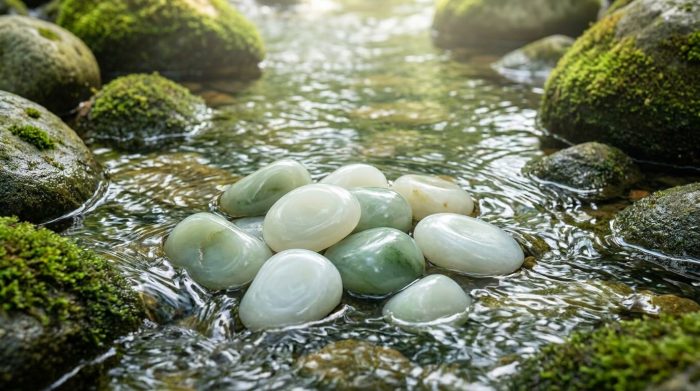
If you are entering the world of Hetian jade collecting, one distinction will determine more of your experience than any other: the difference between seed jade (籽料, zǐliào) and mountain jade (山料, shānliào). These are not different types of jade — they are the same nephrite mineral, shaped by completely different geological journeys. Understanding this distinction is foundational to understanding Hetian jade quality, value, and appreciation.
How Mountain Jade Forms and Is Extracted
Mountain jade (山料) is nephrite that remains in its original geological context — embedded in the rock matrices of the Kunlun Mountains at elevations between 3,000 and 5,000 meters. This jade formed hundreds of millions of years ago through contact metamorphism: magma intruding into dolomite marble under extreme heat and pressure gradually transformed the rock chemistry, producing nephrite over geological timescales. Mountain jade is extracted by mining: modern operations use controlled blasting and cutting to remove jade-bearing rock, then process it to separate the nephrite from surrounding matrix material. The resulting pieces tend to have sharp, angular edges and surfaces that show the original rock face. Mountain jade can be found in large quantities and can be cut to virtually any size — including the massive boulders used for monumental carvings. However, because it hasn't been naturally sorted and selected by river action, quality is more variable than seed jade, and the internal structure can be less consistent.
How Seed Jade Forms: The River's Ten-Thousand-Year Selection
Seed jade (籽料) begins as mountain jade that has been freed from its rock matrix by erosion — freeze-thaw cycles, earthquakes, and weathering over millennia gradually break off pieces of jade from mountain outcrops. These fragments fall into the swift mountain streams that flow north from the Kunlun range — primarily the White Jade River (Yurungkash, 玉龙喀什河) and the Black Jade River (Karakash, 喀拉喀什河). As pieces travel downstream, tumbling against other rocks and sand, several things happen simultaneously: first, the weakest pieces (those with structural flaws, cracks, or inferior composition) break apart and are lost; only the densest, most uniform pieces survive the journey intact. Second, the tumbling action polishes all surfaces smooth, producing seed jade's characteristic rounded, river-worn shape. Third, contact with iron-rich river sediments slowly oxidizes the jade's outer layer, producing the skin (皮色 písè) — a thin layer of color (commonly yellow, red, black, or brown) that is uniquely the mark of genuine seed jade. This natural selection process, operating over thousands of years, produces jade of higher average quality than mountain jade — because the river has already discarded the inferior material.
The Jade Skin: Nature's Certificate of Authenticity
Perhaps the most important distinguishing feature of seed jade is its skin (皮色). This colored outer layer forms over thousands of years as iron and other minerals in the river sediment slowly oxidize into the jade's surface pores. Authentic skin colors include yellow-brown (the most common, from iron oxidation), red (from hematite), black (from manganese dioxide), and grey-white (from weathering). The skin is typically very thin — often less than one millimeter — and shows a natural gradual transition into the white or green jade beneath. Authentic skin cannot be convincingly faked: genuine skin penetrates the jade's surface structure, while artificial skin sits on top of it. Expert collectors use the skin not just for aesthetics but as verification — a piece with genuine, intact skin is confirmed as river-collected seed jade, not mountain jade or an imitation.
Quality and Price Differences
As a general rule, seed jade of equivalent material quality commands a significant premium over mountain jade — often 3 to 10 times higher for equivalent-quality nephrite, and even more for exceptional pieces. This premium reflects several factors: seed jade's natural selection for superior quality; its distinctive skin, which adds aesthetic value; its relative scarcity compared to mountain jade; and its status as the historically preferred form. However, this does not mean all seed jade is better than all mountain jade. Low-quality seed jade (with structural flaws, poor color, or ugly skin) can be less desirable than high-quality, flawless mountain jade. The premium specifically applies to high-quality seed jade with good color, minimal flaws, beautiful skin, and appropriate size. For large pieces (sculptures, decorative objects), mountain jade is often the only practical option regardless of budget.
How to Choose Between Seed and Mountain Jade
Your choice between seed and mountain jade should be guided by intended use and personal values. For jewelry (rings, pendants, bangles), high-quality seed jade is generally preferred: its natural selection for density and uniformity means it typically has better structural integrity for wear, and its skin adds unique character that cannot be replicated. For large decorative pieces (sculptures, display objects), mountain jade is usually the practical choice — it is available in the sizes needed and allows the carver more freedom in design. For investment, exceptional seed jade with beautiful skin and superior material quality tends to hold value best over time. If you prioritize wearing jade in the Confucian tradition — as a daily companion for moral reflection — a piece of genuine seed jade, even if small, offers the most authentic connection to ten thousand years of Hetian jade tradition.
Frequently Asked Questions
Can you identify seed jade from mountain jade just by looking?
Experienced collectors can usually distinguish seed jade from mountain jade by several visual cues. Seed jade has: rounded, river-worn surfaces; characteristic skin (皮色) — the thin colored outer layer; a naturally smooth, polished surface (from river tumbling). Mountain jade typically shows: angular edges and flat faces; no natural skin; saw marks or mechanical surface treatment. However, some unscrupulous sellers artificially create 'skin' on mountain jade to pass it off as seed jade — this is why authentication certificates and reputable sourcing matter.
Is seed jade always better quality than mountain jade?
Not necessarily. Seed jade averages higher quality because the river selection process eliminates weaker material — but individual pieces vary enormously. A piece of flawless, high-quality mountain jade can be superior to seed jade with structural issues or ugly skin. The premium for seed jade reflects its average quality advantage and the aesthetic value of genuine skin — it does not guarantee any specific piece is superior. Always evaluate the specific piece's qualities (texture, color, translucency, freedom from visible flaws) rather than just its type.
How can I tell if jade skin is genuine?
Genuine jade skin (皮色) shows a gradual transition from the skin color into the jade body underneath — the color fades rather than stopping abruptly. Under magnification, genuine skin penetrates into the jade's surface pores. The color of genuine skin is typically uneven and natural-looking, following the jade's surface contours. Artificial skin often appears too regular, stops abruptly at the surface, and can sometimes be detected by its behavior under ultraviolet light. The most reliable test is examination by an expert or testing at a gemological laboratory.
Has seed jade become scarcer in recent years?
Yes, significantly. The traditional river collection of seed jade (collecting pieces from the Yurungkash and Karakash riverbeds during low water seasons) has been heavily restricted by Chinese government regulation to protect the riverbeds. Mountain mining has partially compensated, but genuine river-collected seed jade is now much rarer than it was even twenty years ago. This scarcity has driven prices for high-quality seed jade to historic highs and makes authentic certificates from reputable sources increasingly important for collectors.
Whether you choose seed jade or mountain jade ultimately depends on your priorities, budget, and intended use — but understanding the difference is essential to making an informed choice. At Safinite, all our jade pieces come with full certificates specifying the type and origin of the jade. Explore our authenticated jade collection or visit our jade culture library to deepen your understanding of Hetian jade and its extraordinary tradition.