
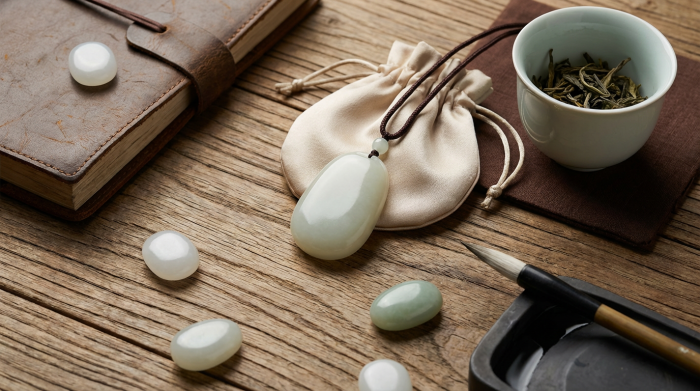
The story of Hetian jade begins in the Kunlun Mountains — one of the world's longest mountain ranges, separating the Tibetan Plateau from the Tarim Basin in northwest China. Hetian 'seed' jade, polished and tempered in rivers for millennia, is especially valued. These mountains are more than a geological formation; they are the source of China's most treasured material, and every piece of authentic Hetian jade carries their ancient energy.
The Kunlun Mountains: Source of China's Finest Jade
The Kunlun Mountain range extends over 3,000 kilometers across central Asia, forming a natural barrier between the Tibetan Plateau and the Tarim Basin. The section in Xinjiang's Hetian prefecture contains some of the world's richest nephrite jade deposits. At altitudes of 3,500 to 5,000 meters, where air is thin and winters brutal, jade-bearing rock outcrops on steep mountain faces. The geological conditions that created these deposits are unique: the ancient collision of tectonic plates produced exactly the right combination of heat, pressure, and mineral composition to form nephrite of exceptional quality. For thousands of years, the only people who knew where to find this jade — and who dared attempt to mine it — were the indigenous Uyghur and Tibetan people of the region, whose knowledge of the mountains was passed down through generations.
Seed Jade: The River's Gift
The most prized Hetian jade is not found in the mountains themselves, but in the riverbeds below. When mountain jade is exposed at the surface by erosion, pieces break off and fall into swift mountain streams. The two main rivers flowing north from the Kunlun Mountains through the Hetian region — the White Jade River (Yurungkash) and the Black Jade River (Karakash) — catch these fragments and carry them downstream. Over thousands of years, the tumbling action of the river polishes the jade smooth, eliminates the weakest pieces (which break apart), and develops a characteristic outer skin (皮色) from mineral contact with river sediments. This river-selection process naturally produces jade of higher average quality than mountain-mined jade. Seed jade (籽料) is named for its rounded, seed-like shape after centuries of river polishing — and it commands the highest prices in the jade market.
Why Hetian Jade Is Unlike Any Other
Hetian seed jade is warm to the touch in a way that other stones are not. It feels substantial and smooth — described in Chinese tradition as feeling like 'congealed fat' (凝脂). When held in the hand, it seems to absorb and reflect body heat in a uniquely intimate way. These sensory qualities are not imagination — they reflect genuine physical properties of Hetian nephrite: an exceptionally dense interlocking fiber structure, low porosity, and specific thermal characteristics. The finest grade, called 'mutton-fat white jade' (羊脂白玉), is creamy white with an almost luminous inner glow. Such jade is extraordinarily rare — it takes exactly the right geological conditions, the right river, and sometimes ten thousand years of polishing to produce a single piece. Discover authentic pieces at Safinite, or learn more at our jade culture center.
Frequently Asked Questions
What is the jade skin (皮色) and why is it valued?
Jade skin (皮色) is the outer layer of color that develops on seed jade through contact with river minerals over thousands of years. The skin can be red, yellow, black, or brown depending on the minerals present. Skilled carvers use the natural skin color as part of their design — incorporating it to create contrast, depth, or symbolic meaning in the finished piece. A piece with beautiful, naturally preserved skin is more valuable than one with the skin removed. Skin is also used to verify authenticity, as it is very difficult to fake convincingly.
How deep in the Kunlun Mountains is jade found?
Jade deposits in the Kunlun Mountains occur at various depths, from surface outcrops to deep veins requiring significant mining operations. The most accessible deposits are at elevations of 3,000-5,000 meters. Some deposits require tunneling into steep mountain faces. The difficulty and danger of high-altitude mining in extreme conditions explains both the historical mystique of Kunlun jade and its high price. Historical miners often worked with primitive tools, risking their lives for each piece extracted.
The Kunlun Mountains, their rivers, and the extraordinary jade they produce represent one of nature's most remarkable gifts. Every piece of authentic Hetian jade at Safinite comes with full certification and traces its origins to this storied source. Explore more at our jade knowledge library.