
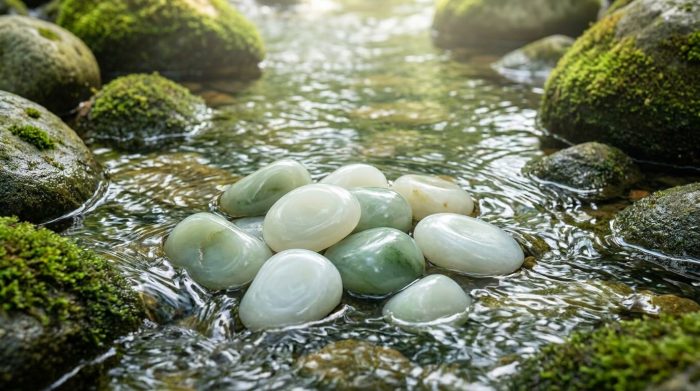
The story of Chinese jade through the dynastic period is the story of a civilization discovering, expanding, and refining its relationship with the world's most storied stone. Four monumental jade carvings, the Four Great National Treasures, were created and presented to the world. From the austere ritual jades of the Zhou to the exuberant imperial collections of the Qing, each era left its distinctive mark.
From Han Opulence to Tang Elegance
The Han dynasty (206 BCE-220 CE) marked a peak of jade opulence. Han aristocrats wore elaborate jade pendants; Han emperors were buried in complete jade suits — thousands of jade plaques sewn together with gold, silver, or bronze wire according to the wearer's rank. The famous Han jade burial suits (玉衣) from Mancheng tombs demonstrate both Han wealth and the belief that jade could preserve the body after death. The subsequent Tang dynasty (618-907 CE) brought a shift toward elegance and international influence. Tang jade incorporated designs from Central Asia and the Islamic world, as the Silk Road brought global influences to the imperial capital of Chang'an. The Tang phrase 'gold and jade, a perfect match' (金玉良缘) became a cultural metaphor for ideal unions that persists to this day.
Song Refinement, Yuan Boldness, Ming Mastery
The Song dynasty (960-1279 CE) prized understated elegance — jade objects became smaller, more refined, and more attuned to natural beauty. Song literati collected ancient jades and wrote about jade appreciation as a form of scholarly cultivation. The Yuan dynasty (1271-1368 CE), founded by Mongol rulers, brought a bolder aesthetic. The massive Jade Sea wine vessel (渎山大玉海) commissioned by Kublai Khan remains one of the world's largest jade carvings. The Ming dynasty (1368-1644 CE) saw jade become more widely accessible and artistically inventive. The master carver Lu Zigang (陆子冈) rose to such fame that his signed pieces became collector's items — a first in Chinese jade history where individual artistic genius was recognized and celebrated.
The Qing Dynasty: Jade's Imperial Zenith
Under the Qing dynasty (1644-1912 CE), particularly the reign of Emperor Qianlong (1736-1795), jade culture reached its imperial zenith. Qianlong was obsessed with jade — he collected jade from throughout his empire, commissioned massive jade carvings, and wrote thousands of poems about specific jade objects in his collection. The most famous Qing imperial jade creation is 'Yu the Great Taming the Waters' (大禹治水图玉山子), a boulder of nephrite weighing over 5,000 kilograms, carved over a decade by hundreds of craftsmen. Qianlong's jade collection is now largely housed in the Palace Museum in Beijing and the National Palace Museum in Taipei. The Qing dynasty's jade legacy defines much of what collectors seek when they prize imperial-style jade today. Explore our certified jade collection or visit our jade history library.
Frequently Asked Questions
Who was Lu Zigang and why is his jade so valuable?
Lu Zigang (陆子冈) was a master jade carver of the Ming dynasty (1368-1644 CE), considered one of the greatest jade artisans in Chinese history. His signature innovation was inscribing his name on finished jade pieces — unprecedented in a tradition where craftspeople remained anonymous. His pieces, typically thin plaques with landscape or figure decoration on one face and calligraphy on the other, demonstrated extraordinary technical refinement. Genuine 'Zigang jade' today commands astronomical prices; the vast majority of pieces marketed as Zigang jade are later imitations.
What is the most famous jade carving in Chinese history?
The most famous jade carving is likely 'Yu the Great Taming the Waters' (大禹治水图玉山子), commissioned by Emperor Qianlong and completed in 1788. The piece weighs over 5,000 kilograms, stands 2.24 meters tall, and depicts the legendary hero Yu controlling a great flood. It required a nephrite boulder from Xinjiang to be transported to Beijing by sled and boat, carved by hundreds of craftsmen over ten years following designs sent from the imperial court. It is now displayed in the Palace Museum in Beijing.
Five thousand years of dynastic jade history have produced a tradition of extraordinary depth and richness. At Safinite, we continue this tradition with certified authentic Hetian jade. Explore the full story at our jade history library, or discover your piece of history in our collection.