
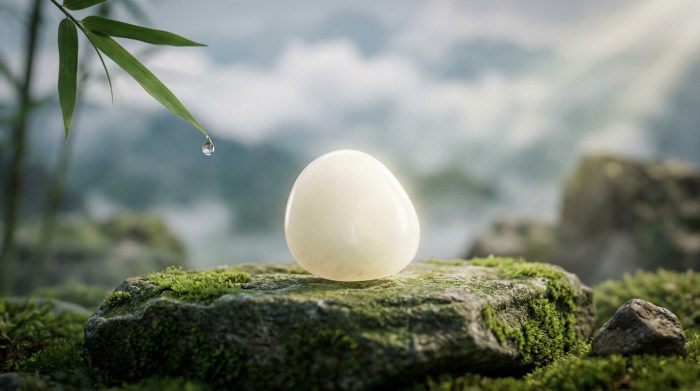
Most stones are just stones. Beautiful, perhaps. Rare, possibly. But in the end, matter — neutral, silent, without moral implication.
Jade is not like other stones.
For more than two thousand years, the philosophical traditions of the East looked at jade and saw something that went far beyond beauty or rarity. They saw a mirror. They saw, encoded in its physical qualities — its warmth, its toughness, its translucent purity — the virtues that all human beings should aspire to embody. They developed a sophisticated philosophical framework that made jade not just the most beautiful of stones, but the most instructive.
The great philosopher Confucius identified eleven virtues in jade. Others found seven, or nine. The most enduring formulation identifies five — and each one is a lesson in how to be more fully human.
The Five Virtues, Written in Stone
Benevolence (Ren): Jade is warm and smooth, and its luster radiates outward without diminishing. This, the philosophers said, is benevolence: warmth given freely, illumination that costs nothing to share, a quality of character that makes the world around it brighter simply by existing. A person of benevolence does not give warmth only when it is convenient, or only to those who deserve it. They give it as jade does — constantly, quietly, without keeping score.
Righteousness (Yi): When you cut a piece of jade and examine the fresh face, you find that the interior is identical to the exterior. There is no deception in jade — no hidden flaw masked by a beautiful surface, no outer performance that conceals an inner betrayal. This is righteousness: being, inside, exactly what you appear to be outside. Consistency between the private self and the public self. Integrity that holds whether anyone is watching or not.
Wisdom (Zhi): Jade is dense and fine-textured — its crystalline structure built over millions of years of slow, patient growth. This corresponds to wisdom: not the quick cleverness of the moment, but the deep understanding that accumulates over a lifetime of careful attention. Wisdom, like jade, cannot be rushed. It forms in the dark, over time, under pressure — and when it finally appears, it is solid all the way through.
Courage (Yong): Despite its apparent gentleness — its smoothness, its quiet colors, its yielding warmth — jade is extraordinarily tough. It does not shatter under pressure. It does not crack at the first difficulty. It holds its form. This is courage: not the absence of fear, but the refusal to let fear change what you essentially are. The toughness that absorbs the world’s blows and remains, fundamentally, itself.
Purity (Jie): The finest jade is pure throughout — consistent in quality, free of hidden impurities, the same beautiful thing from edge to center. This is purity: not mere cleanliness, but moral consistency. The quality of not having one set of values in public and another in private. The quality of being genuinely what you claim to be.
A Philosophy You Can Hold in Your Hand
What is remarkable about this tradition is its physicality. These virtues are not abstract ideas written in a book and then forgotten. They are encoded in an object that the Eastern gentleman was expected to carry on his body at all times. When his hand touched the jade, he was touching his own aspirations. When the jade moved against his skin, he was reminded, moment by moment, of what he was trying to become.
“A gentleman, for no good reason, should not be without his jade pendant.”
— Confucius
A Mirror, Not a Trophy
The genius of this philosophical tradition is that jade was never meant to be a reward for virtue already achieved. It was a practice tool for virtue still being cultivated. Carrying jade was not a statement of “I am good.” It was a question asked of oneself, repeatedly, every day: Am I warm enough? Consistent enough? Patient enough? Tough enough when it matters? Pure enough in my private moments?
In this sense, jade was the world’s first wearable philosophy — centuries before anyone invented the phrase “wearable technology.” Not technology for the body, but technology for the soul. A small, beautiful, ancient machine for becoming a better human being.
Look at your jade differently now. It is not just a stone. It is a conversation between the earth’s deepest patience and your own highest aspirations. Hold it long enough, and it will ask you things about yourself that no other object ever has.