
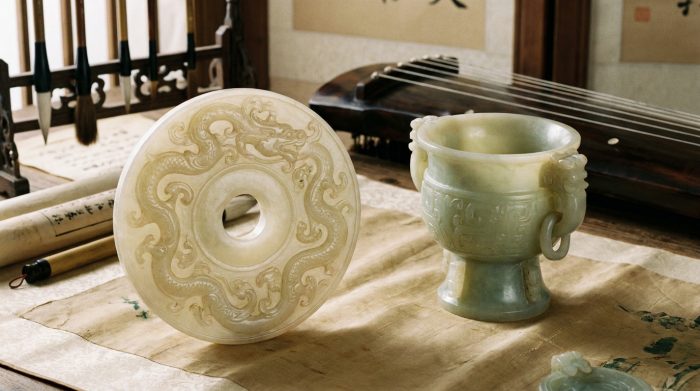
If you could stand outside history and watch civilizations rise and fall like tides, one thing would remain constant through everything: somewhere in the center of it, jade.
At the height of every dynasty, in the burial chambers of every emperor, in the rituals of every era, in the hands of every generation of artists who ever tried to make something worthy of the word “beautiful” — jade was there. It outlasted every government that used it, every ruler who coveted it, every ideology that tried to define it. After five thousand years of recorded history, it is still here, still warm in the hand, still asking us the same questions it always has.
This is its journey.
The Age of Ritual: When Jade Was the Language of the Sacred
The earliest dynasties inherited a jade tradition already millennia old — and they understood immediately what they had received. The jade Bi disc, the Cong tube, the ritual scepters called Gui and Zhang: these were not merely beautiful objects. They were the instruments through which human beings communicated with heaven. In the ceremonial systems of the early Eastern dynasties, specific jade forms corresponded to specific cosmic forces. To hold the right piece of jade in the right ritual context was to make the universe listen.
The Western Zhou dynasty took this further, creating a comprehensive system in which different jade objects corresponded to different levels of social hierarchy — a material grammar of civilization, making jade not just sacred, but structural. The world was made of relationships, and jade was the substance that marked them.
The Age of the Gentleman: When Jade Became Philosophy
During the turbulent centuries of the Warring States period, when old certainties crumbled and thinkers struggled to articulate the values that could hold civilization together, jade took on new meaning. The great philosophers — Confucius, Xunzi, Guanzi — looked at jade and saw a mirror of the virtues they were trying to teach. Benevolence in its warmth. Righteousness in its consistency. Wisdom in its density. Courage in its toughness. Purity in its clarity.
The jade pendant became the wearable embodiment of the philosophical ideal: a daily reminder, carried against the body, of what one was trying to become. Two thousand years of Confucian culture would be built on this foundation — the idea that what we carry close to us shapes who we are.
And then there were the great stories. Bian He, who presented a rough jade stone to two successive kings and was punished both times for what they dismissed as deception, until a third king finally cut the stone open and found the most beautiful jade in the kingdom within. A story not about jade, but about the costs of recognizing truth when it does not yet look like what truth is supposed to look like.
The Imperial Age: When Jade Secured the World
With the unification of the realm under the first great empire, jade became the explicit material of political legitimacy. The imperial seal was carved from the finest jade — the object that made an emperor’s commands binding, that made a dynasty real. To possess the jade seal was to possess the mandate of heaven. To lose it was to lose everything.
The Han dynasty created one of the most haunting expressions of jade culture in all of history: the jade burial suit. Thousands of small jade plaques, sewn together with gold or silver wire, encased the body of the deceased royal — jade’s believed properties of preservation and protection enlisted to guard the ruler against the decay of death. Found in tombs two thousand years later, these suits remain among the most extraordinary objects ever produced by human hands.
“Each age of great prosperity creates its great jade masterpiece. Jade does not merely record history — it embodies it.”
The Age of Refinement: Tang, Song, and the Cultivated Life
The Tang dynasty brought a new openness — an empire that absorbed aesthetic influences from across Asia and beyond, producing jade objects of extraordinary grace that bear the imprints of encounters with Persia, with Central Asia, with the world beyond the mountains. The phrase the Tang gave the world — “gold and jade, a perfect match” — became a permanent idiom for the ideal partnership, used ever since.
The Song dynasty retreated from this expansiveness into something more interior. Song jade was quieter, more meditative — objects for the scholar’s study rather than the imperial hall. Their value lay not in size or spectacle but in the quality of observation they rewarded: the longer you looked, the more you found.
The Qing dynasty emperor Qianlong brought the tradition to one of its most extraordinary expressions. Obsessed with jade in the way that only truly cultivated collectors are obsessed — with the reverence that comes from genuine understanding — he assembled a collection numbering in the thousands of pieces and commissioned what remains one of the world’s most ambitious works of jade sculpture: a ten-ton boulder, carved over years by hundreds of craftsmen, depicting the legendary figure of Yu the Great taming the waters of a great flood. It still exists. It is still astonishing.
Today: The Living Tradition
The jade tradition continues. It has never stopped. Workshops throughout the East maintain techniques refined over fifty centuries. Contemporary masters create objects that stand in the long conversation that began in the Neolithic and has never, not once, fallen silent.
Jade endures because what it represents endures: the human aspiration toward beauty, virtue, and permanence. In every era, in every dynasty, in every generation, human beings have looked at jade and recognized something that exceeded ordinary matter. That recognition is not superstition or nostalgia. It is wisdom. It is the long memory of a species that has been learning, for ten thousand years, what it means to be worthy of the world it lives in.