
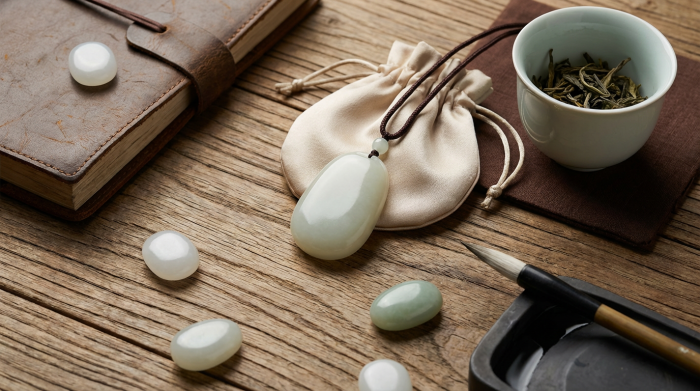
In the spring of 501 BCE, Confucius — then in his early fifties and serving as a government official in the state of Lu — was asked by a student: 'Why do gentlemen value jade so highly? Is jade really better than ordinary stone, or is it just fashion?' Confucius's answer — recorded in the Book of Rites — was one of the most eloquent statements in the history of philosophy about why material objects can serve moral development. Understanding his answer illuminates not just why jade matters, but how beautiful things can make us better people.
Confucius's Answer: Jade as Moral Mirror
Confucius replied with a series of correspondences: jade's warmth corresponds to benevolence; its luster (visible even through translucency) corresponds to wisdom; its hardness and strength correspond to righteousness; its sharp edges that do not harm correspond to justice; its inclinations not concealed by its beauty correspond to loyalty. This wasn't a complete list — different passages give different numbers of virtues, ranging from five to eleven — but the principle is consistent: jade's physical properties are read as moral qualities. Confucius was not saying jade is metaphorically like virtue. He was saying jade genuinely embodies virtue — that the same natural processes that make jade warm and translucent and tough are expressions of the same cosmic principles that generate human moral excellence. Jade is not a symbol of virtue; it is virtue made material.
The Practice of Wearing Jade: Ethics Through Habit
From this philosophical foundation, Confucian culture developed a sophisticated practice of using jade for self-cultivation. The gentleman was to wear jade pendants at all times (except in mourning). As he moved through his day, the pendants would clink together — producing the characteristic sound of jade-on-jade that Confucian texts describe with great precision. This sound was not background noise. It was intentional: the Rites of Zhou specifies that the gentleman's pace should be measured by his jade's sound — walking fast enough to produce regular rhythm, slowly enough that the sound remains clear and controlled. If he walked too quickly (suggesting haste and agitation), his jade would clatter; if too slowly (suggesting torpor), it would fall silent. The jade's sound literally modulated his bearing. This is embodied ethics: virtue not just thought about, but felt and heard in every step.
The Three Traditions: Confucian, Buddhist, and Taoist Perspectives
The depth of jade's philosophical significance lies in its resonance across China's three great traditions. For Confucians, jade is a moral mirror and social technology — it embodies virtue and mediates social relationships through ritual gift-giving and ceremonial use. For Taoists, jade is a model of natural perfection — formed without human intervention over millions of years, following the Tao (Way) of the universe. The Taoist carver 'follows the material,' discovering the design already present in the stone rather than imposing one — a practice of wu wei (effortless action). For Buddhists, jade's journey from rough stone to lustrous gem through patient polishing is a metaphor for spiritual development: the polishing of the mind to reveal its inherent luminosity (Buddha nature). These three perspectives are not contradictory — they illuminate different facets of the same reality. Jade is morally instructive (Confucian), naturally perfect (Taoist), and transformatively beautiful (Buddhist) all at once.
Jade as Gift: Extending Philosophy into Relationship
One of the most practical expressions of Confucian jade philosophy is the tradition of jade gift-giving. Giving jade is not merely an exchange of value — it is a moral act. When a parent gives jade to a child leaving for college, they are giving not just a beautiful object but a philosophical companion: jade will remind the child of the virtues the parent hopes they will embody. When jade is exchanged at a wedding, the couple is being given the Five Virtues as a basis for their partnership. When jade is passed from a dying grandparent to a grandchild, the family's moral legacy passes with it — the jade carries the virtue of everyone who has ever worn it. This is why jade heirlooms are so significant in Chinese families: they accumulate not just monetary value but moral value, becoming richer with each generation's integrity.
Modern Jade Practice: How Ancient Wisdom Applies Today
The Confucian philosophy of jade is not historical curiosity — it is a practical system that works as well today as it did 2,500 years ago. Modern jade wearers need not hold any particular philosophical belief to benefit from jade's philosophical dimensions. Simply wearing genuine Hetian jade creates a physical prompt for reflection: you feel its warmth and remember benevolence; you notice its consistency and think about your own integrity; you hear its gentle sound and consider the clarity of your recent judgments. Using a beautiful object as a mindfulness prompt is a practice that works across cultural contexts — and jade is among the most beautiful, most durable, and most meaningfully laden objects available for this purpose. The philosophy enriches the wearing; the wearing enriches the philosophy.
Frequently Asked Questions
What specific jade did Confucius wear?
Historical records do not specify exactly what jade Confucius wore, but his era (551–479 BCE) corresponds to the Spring and Autumn period, when jade pendant assemblages were standard adornment for educated men. These would typically include bi disc pendants, huang crescent pendants, and various smaller jade ornaments arranged in layered systems that clinked as the wearer moved. Confucius would have worn jade appropriate to his official rank and scholarly standing — relatively modest by royal standards, but signaling his cultivated status.
How did the concept of 'playing with jade' (玩玉) develop from Confucian philosophy?
Confucian jade practice emphasized constant, mindful engagement with jade as the basis of its moral value. This evolved into the practice of 玩玉 (wányù, literally 'playing with jade') — a contemplative practice of handling, rotating, and examining jade in one's hands. This is not idle fidgeting but deliberate sensory engagement: feeling the warmth, observing the luster in different lights, listening to the tone, noticing the texture. The practice is simultaneously sensory pleasure, mindfulness practice, and moral education. It also physically benefits the jade: natural skin oils gradually improve the stone's luster, creating an intimate relationship between the jade's appearance and its owner's attention.
Is there a Confucian view on which types of jade are most appropriate?
Classical Confucian texts specify that jade's moral value lies in its genuine physical qualities — warmth, translucency, toughness, natural purity. This implies that the most morally appropriate jade is genuine, authentic jade of the highest quality you can afford — not imitation jade, not treated jade, not artificially enhanced jade. The moral requirement for righteousness (inside and outside matching) applies to the jade itself: genuine jade is righteous; artificial jade is not. Safinite's commitment to certified authentic Hetian nephrite reflects this philosophical value.
How does jade philosophy relate to the concept of 'face' (面子) in Chinese culture?
While 'face' (面子) is often understood superficially as social reputation management, it has deeper Confucian roots in the concept of social harmony maintained through proper conduct. Jade gifts and displays are not mere status signals — they are expressions of social relationships and moral commitments. Giving fine jade to honor someone acknowledges their value and your commitment to the relationship. Wearing jade in professional contexts signals a commitment to the virtues jade embodies. The confusion between genuine Confucian jade practice and mere status display is worth noting: the tradition emphasizes inner quality expressed through outer form, not outer form substituting for inner quality.
Confucius wore jade because he understood that moral development is not just a matter of thought, but of daily embodied practice — and beautiful objects that embody virtue are uniquely powerful teachers. This wisdom remains as relevant today as it was 2,500 years ago. Discover your philosophical companion at Safinite's jade collection, or explore the full depth of Confucian jade tradition at our philosophy library.