
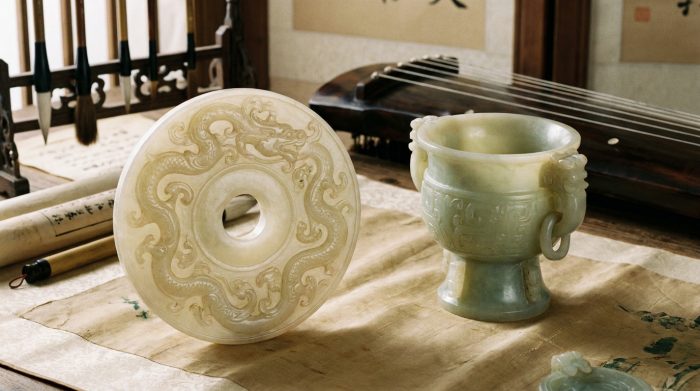
What makes jade beautiful? The answer is more complex and more fascinating than it might first appear. Its colors can be brilliant, with emerald green beautifully setting off ruby red. Chinese jade aesthetics engage all the senses, and the standards developed over thousands of years of connoisseurship capture something genuinely remarkable about this extraordinary material.
The Sensory Experience of Jade
Touch is primary in jade appreciation. The Chinese term often used to describe fine jade — 'warm jade, smooth like fat' (温润如脂) — captures the stone's most distinctive tactile quality. Unlike cold, hard stone, fine nephrite jade warms quickly against the skin and then seems to hold that warmth. It feels smooth in a particular way — yielding rather than slippery, substantial rather than heavy. When two pieces of jade are tapped together, they produce a clear, resonant tone — the 'golden sound, jade chime' (金声玉振) that became a metaphor for perfect harmony. Sight matters too: connoisseurs observe jade in different lights, looking for even distribution of color, the right degree of translucency (neither opaque nor overly transparent), and the characteristic 'grease luster' (油脂光泽) that distinguishes fine nephrite from lesser stones.
Color, Luster, and Texture: The Connoisseur's Language
Chinese jade connoisseurs have developed extraordinarily precise vocabulary for jade's visual qualities. The highest-grade white Hetian jade is called 'mutton-fat' (羊脂): creamy white with a warm inner glow, like high-quality fat rendered to a smooth consistency. 'Like congealed fat' (如凝脂) describes the luster — a smooth, oily gleam rather than the glossy shine of glass. For color distribution, ideal jade should have even, natural color throughout — not mottled or unevenly distributed. Translucency should be moderate: jade that is too opaque looks dull; jade that is too transparent suggests structural weakness. The finest jade allows light to penetrate slightly, creating a sense of depth — as if lit from within. These precise standards developed because small differences in these qualities correspond to large differences in the geological conditions that produced the jade, and thus in its rarity.
Appreciating Jade as a Living Practice
Jade appreciation in Chinese culture is not passive — it is a practice, a skill, and a relationship. The tradition of 'playing with jade' (玩玉) involves holding and handling jade regularly, allowing your body oil and warmth to slowly nourish the stone. Over time, this regular handling is said to improve jade's luster — the stone and the person become attuned to each other. Connoisseurs develop sensitivity to jade's qualities through years of handling many different pieces, building an intuitive understanding that guides their eye and hand. This is why jade experts can often assess quality by touch alone, in the dark. At Safinite, all our Hetian jade pieces are selected for their sensory qualities — the warmth, smoothness, and luster that make jade a genuine tactile pleasure as well as a visual delight. Explore our collection or learn more at the jade aesthetic library.
Frequently Asked Questions
What is the correct way to appreciate jade's color?
Jade color should be evaluated in natural daylight, not artificial light which can distort color perception. For white jade, look for warm creamy white rather than cold bluish white — warmth indicates quality. Color should be evenly distributed, not mottled or concentratedpatch. For green jade (jadeite or green nephrite), the color should be natural and not too vivid — overly saturated color in nephrite often indicates treatment. Look for depth: fine jade has color that seems to come from inside rather than just on the surface.
What does it mean that jade gets better with wearing?
In Chinese jade tradition, wearing jade against the skin is believed to gradually improve the stone's appearance and to benefit the wearer. The physical reality is that natural skin oils and warmth slowly penetrate jade's surface pores, enhancing luster and preventing drying. Regular handling polishes micro-surface irregularities. This process, called 'playing with jade' (玩玉) or 'nurturing jade' (养玉), can visibly improve a piece over years of wear. It also creates an intimate relationship between wearer and stone that is central to the Chinese jade experience.
The aesthetics of jade appreciation form one of the world's most refined traditions of sensory connoisseurship — developed over thousands of years of intimate engagement with this extraordinary material. At Safinite, we select every piece for its sensory excellence. Explore our jade collection or visit our aesthetic appreciation guide.