
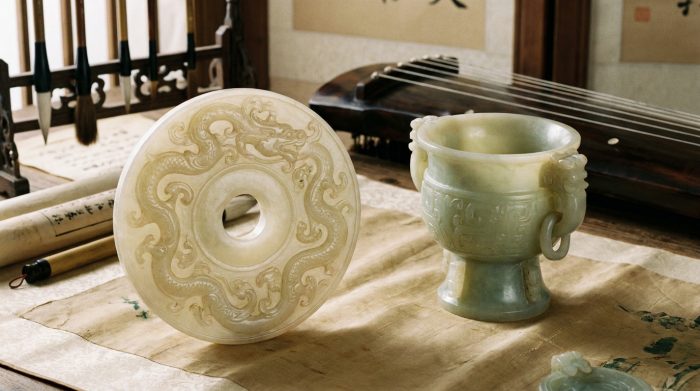
No material in human history has maintained its cultural centrality for as long as jade has in China. While other civilizations rose and fell and changed their prized materials — Greece from bronze to marble, Rome from terracotta to porphyry — China's jade tradition ran unbroken for ten thousand years, adapting to each era's aesthetic while maintaining its essential significance. To trace jade through Chinese history is to trace Chinese civilization itself.
The Jade Age: Neolithic Cultures (7000–2000 BCE)
China's jade story begins in the Neolithic period, long before writing or bronze. The Xinglongwa culture (6200–5400 BCE) in Inner Mongolia produced some of China's earliest jade ornaments — simple but sophisticated. The Hongshan culture (4700–2900 BCE) created extraordinary jade animal sculptures: C-shaped pig-dragons, owls, tortoises, and bear-human figures, all made from local Xiuyan serpentine using only stone tools. These pieces were not decorative — they were ritual implements, believed to connect their owners to spiritual powers. The Liangzhu culture (3400–2250 BCE) reached a remarkable apex: elaborate jade Cong tubes and Bi discs, carved with intricate divine-human-animal masks, requiring skills that astonish modern experts. Liangzhu jade was the first great jade art tradition, and it established jade's role as the premier ritual material of Chinese civilization.
Bronze Age Jades: Xia, Shang, and Zhou Dynasties (2100–256 BCE)
As China entered the Bronze Age, jade culture continued to develop alongside the new metal technology. Xia dynasty (2100–1600 BCE) jade began to show the ritual scepter forms (Gui and Zhang) that would become standard ceremonial implements. Shang dynasty (1600–1046 BCE) jade demonstrated dramatically improved technique — finer lines, more complex three-dimensional forms, more sophisticated design vocabulary (including the famous taotie animal mask). The Zhou dynasty (1046–256 BCE) systematized jade use in ritual: the Rites of Zhou specified exactly which jade objects different ranks of officials should use, encoding social hierarchy in material form. During the Spring and Autumn and Warring States periods (770–221 BCE), jade pendants reached their artistic height — elaborate multi-piece assemblages carved with intertwining dragons and phoenixes showed a freedom and dynamism that reflected the intellectual ferment of this era.
Imperial Jade: Qin and Han Dynasties (221 BCE–220 CE)
The first imperial unification brought new dimensions to jade use. The Qin dynasty (221–206 BCE) established the imperial jade seal — the symbol of legitimate authority — as the supreme jade object. Han dynasty (206 BCE–220 CE) jade culture reached an extraordinary combination of scale and refinement. Han aristocrats wore elaborate multi-piece jade pendant assemblages. Han nobles were buried in complete jade suits: thousands of jade plaques sewn with gold, silver, or bronze wire according to rank, in the belief that jade could preserve the body's vital energy after death. The jade suit of Prince Liu Sheng and his consort Lady Dou Wan, discovered at Mancheng in 1968, remains one of the most extraordinary archaeological discoveries ever made. Han jade also shows remarkable technical progress — the famous 'Han Eight Cuts' style (汉八刀) used minimal, decisive incision lines to create powerful, expressive figures with extraordinary economy of means.
Middle Period: Wei-Jin Through Tang Dynasties (220–907 CE)
The post-Han period brought changes in jade use. Wei-Jin period literati (220–420 CE) developed a vogue for consuming powdered jade — believed to be an elixir of immortality — reflecting the period's Daoist influence. Traditional Chinese medicine also began incorporating jade into treatment protocols. The Tang dynasty (618–907 CE) brought a cosmopolitan elegance to jade: the Silk Road brought foreign influences from Central Asia and the Islamic world, and Tang jade incorporated round, plump forms that reflected Tang aesthetic ideals of abundance and international exchange. The phrase 'gold and jade, a perfect match' (金玉良缘) — Tang in origin — became a cultural metaphor for perfect unions that persists to this day. Tang jade shows the confidence of a civilization at its most expansive.
Refinement and Innovation: Song, Yuan, and Ming (960–1644 CE)
Song dynasty (960–1279 CE) jade reflected the period's celebrated literati culture. Song scholars prized understated elegance — jade objects became smaller, more refined, and more attentive to natural beauty. Song literati collected and wrote about ancient jades with the same scholarly attention they gave to bronze and ceramics. The Yuan dynasty (1271–1368 CE), under Mongol rulers, brought bold aesthetics: the massive Jade Sea wine vessel (渎山大玉海) commissioned by Kublai Khan remains one of the world's largest jade carvings. Ming dynasty (1368–1644 CE) jade saw two major developments: a great master carver, Lu Zigang, rose to personal fame unprecedented in the tradition — signing his work and being collected for his individual artistic identity; and jade use spread more widely among common people, no longer confined to ritual and aristocracy.
Imperial Zenith: Qing Dynasty (1644–1912 CE)
Under the Qing dynasty, particularly Emperor Qianlong's reign (1736–1795), jade culture reached its imperial zenith. Qianlong was obsessed with jade — he collected it from across his empire, commissioned colossal carvings, and wrote thousands of poems about individual jade objects. The most famous result is 'Yu the Great Taming the Waters' — a nephrite boulder weighing over 5,000 kilograms, carved by hundreds of craftsmen over ten years, depicting the legendary hero controlling a great flood. The Qing jade workshops in the Forbidden City produced jade of extraordinary technical perfection, establishing aesthetic standards that continue to define 'imperial jade' for collectors today.
Modern Revival (1949–Present)
After the disruptions of the late Qing and Republican periods, Chinese jade culture has experienced a remarkable revival. Under the People's Republic, four monumental jade carvings — the 'Four National Treasures' — were created for international exhibition. In the reform era (post-1978), rising Chinese wealth combined with decreasing supply of fine Hetian jade drove prices to historic levels. The 2008 Beijing Olympics medals — gold inlaid with white nephrite jade — introduced Chinese jade culture to a global audience. Today, Hetian jade operates as a sophisticated collecting market, with exceptional pieces commanding prices that rival fine art.
Frequently Asked Questions
When did jade first become important in China?
Archaeological evidence shows jade being used in ritual contexts in China at least 8,000 years ago, with some sites pushing the timeline to 9,000 years. The Xinglongwa culture (6200–5400 BCE) produced the earliest confirmed jade ornaments. By the Hongshan culture (4700–2900 BCE), jade had become the primary ritual material of Chinese civilization, used in sophisticated shamanic ceremonies. Jade's importance in China is thus older than writing, older than bronze, and older than recorded history.
What was the jade imperial seal and why did it matter?
The imperial jade seal (玉玺 yùxǐ) was the physical symbol of legitimate imperial authority in China. According to tradition, the first Qin emperor had the legendary He's Jade — the most famous jade in Chinese history — carved into a seal bearing the inscription 'Heaven has commanded to rule and cherish the people.' Subsequent dynasties sought the seal (or created their own) as essential legitimation. The seal represented the mandate of heaven in physical form. Its loss was considered catastrophic — suggesting heaven had withdrawn its mandate from the dynasty.
Why were Han dynasty jade burial suits created?
Han dynasty jade burial suits (玉衣) were made based on the belief that jade could preserve the body's vital energy (qi) after death, preventing decay and facilitating the soul's journey to heaven. The suits were composed of thousands of jade plaques sewn together with wire — gold wire for princes and princesses of the highest rank, silver for lesser nobles, bronze for officials. The investment was extraordinary: a complete jade suit might use over 2,000 pieces and require years of skilled labor. Ironically, modern archaeology has found that bodies in jade suits were not particularly well-preserved — but the cultural belief was genuine and absolute.
How has jade changed since the Qing dynasty?
Since the Qing dynasty (ended 1912), jade culture has undergone several major changes: the loss of imperial patronage initially caused a decline; nationalization of jade workshops under the early People's Republic; a dramatic market revival since the 1980s as Chinese wealth grew; increasing scarcity of fine Hetian seed jade driving prices to historic highs; and globalization bringing Chinese jade culture to international collectors. Today's jade market combines traditional aesthetic values with contemporary collector sophistication — prices for exceptional pieces now rival fine art and fine diamonds.
Ten thousand years of jade history have produced a tradition of extraordinary depth — a continuous thread connecting modern Chinese civilization to its Neolithic origins. Understanding this history transforms your experience of jade from appreciation of a beautiful stone to participation in one of humanity's most remarkable cultural traditions. Explore more at Safinite's jade history library, or find your connection to this history in our authenticated jade collection.