
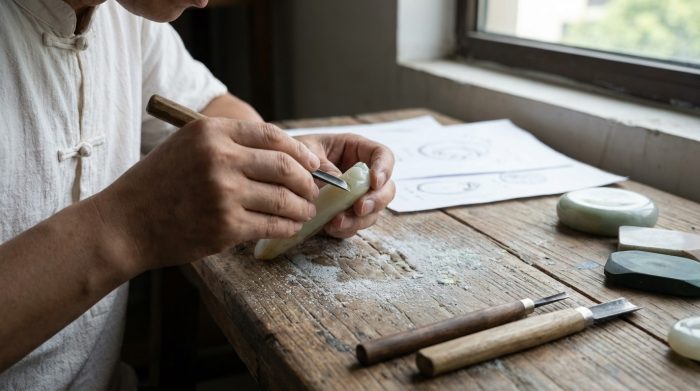
Few materials in human history have been as philosophically significant as jade in China. It is also associated with Buddhist wisdom and is deeply embedded in Confucian classical tradition. The fact that Confucians, Buddhists, and Taoists all found deep meaning in jade — from completely different philosophical starting points — speaks to jade's extraordinary capacity to embody universal human values.
The Confucian View: Jade as Moral Mirror
For Confucian thinkers, jade was primarily a moral material — a physical embodiment of the virtues a gentleman (junzi) should cultivate. Confucius himself compared the qualities of jade to the qualities of a noble person: its warmth to benevolence, its translucency to wisdom, its toughness to courage, its purity to moral integrity. The Confucian gentleman wore jade pendants as a constant reminder of these virtues — the sound of jade clinking as he walked served as an auditory reminder to maintain dignified, measured movement. This practice transformed wearing jade from ornamentation into a daily spiritual discipline. The great Confucian texts, from the Analects to the Rites of Zhou, are filled with jade references that encode moral teachings in material form.
The Taoist and Buddhist Perspectives on Jade
Where Confucians saw jade as a moral mirror, Taoists saw it as a model of natural perfection. Jade forms without human effort, over millions of years, following the natural Way (Tao) of the universe. The Taoist concept of wu wei (non-action, or effortless action) finds a perfect emblem in jade: the stone achieves its perfection by yielding to natural processes, not by forcing itself into shape. The finest jade carvers — working in the Taoist spirit — speak of 'listening to the stone' rather than imposing a design upon it. Buddhist tradition found in jade a metaphor for Buddha nature: like jade, which is precious even when hidden in rough rock, Buddha nature is present in all beings even when obscured by ignorance and desire. The act of polishing jade — revealing the beauty hidden within — parallels Buddhist practice of revealing one's inherent enlightenment.
Jade as Universal Spiritual Symbol
The remarkable fact that Confucianism, Buddhism, and Taoism all found profound meaning in jade — from their very different philosophical perspectives — speaks to jade's extraordinary position in Chinese spiritual life. Jade doesn't belong exclusively to any one tradition; it transcends them all and serves as a meeting point where China's diverse philosophical currents converge. This is why jade remains meaningful to Chinese people regardless of their specific religious or philosophical orientation. It is a cultural universal, a shared symbol of the best that human beings can aspire to. Whether you approach it as a moral reminder (Confucian), a natural wonder (Taoist), or a metaphor for inherent goodness (Buddhist), jade speaks to something deep in the human spirit. Explore this tradition at Safinite's jade culture center or browse our collection.
Frequently Asked Questions
Why is jade associated with Buddhism in China?
Chinese Buddhism absorbed local cultural symbols and gave them Buddhist meanings. Jade's natural purity, its transformation from rough stone to lustrous gem through patient work, and its inherent beauty made it a natural metaphor for Buddhist concepts: Buddha nature (present in all beings), spiritual purification (like polishing jade), and the transformation from ignorance to enlightenment. Jade was also used in Buddhist ritual objects and temple decorations throughout Chinese history.
Can jade appreciation be a spiritual practice?
In Chinese tradition, jade appreciation (赏玉) has always had a contemplative dimension. The practice of holding jade, feeling its warmth, observing its color and texture in different lights, and reflecting on its qualities was understood as a form of self-cultivation — a way of quieting the mind and connecting with deeper values. Whether one approaches this practice from a Confucian, Buddhist, or Taoist perspective, jade provides a tangible focus for contemplation and a reminder of the qualities one wishes to cultivate.
The meeting point of Confucianism, Buddhism, and Taoism in jade culture reveals the stone's deepest significance: it is a universal symbol of human aspiration toward virtue, naturalness, and wisdom. Explore more at Safinite's jade library or find your perfect piece in our authenticated collection.