
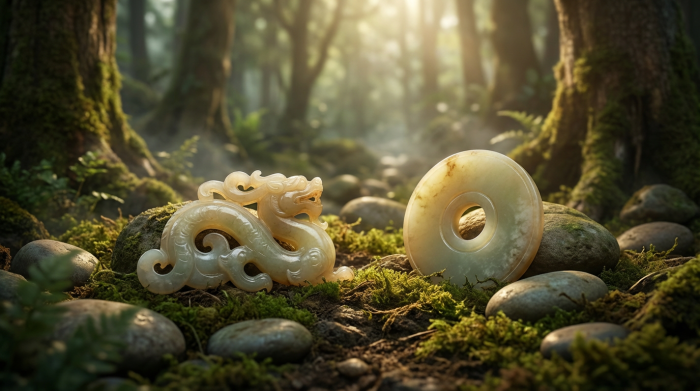
There is an object in a museum in Beijing — a small, coiled jade figure, C-shaped, smooth as a secret, carved from a stone the color of deep sea water — that is approximately five thousand years old. No one knows exactly what it meant to the people who made it. No one knows what name they gave it, what prayers they spoke over it, what it cost them in labor and reverence to bring it into existence.
But look at it for long enough, and you feel something. A quality of intention. Of meaning compressed so densely into this small curve of jade that it still radiates, across fifty centuries of silence, into the present moment.
This is the C-shaped jade dragon of the Hongshan culture — and it is one of the oldest, and most moving, works of art in human history.
The Jade Age: A Civilization We Are Still Learning to Read
Archaeologists use the term “Jade Age” to describe the period when jade was the dominant sacred material of the cultures of ancient East Asia — preceding the Bronze Age by a thousand years or more. During this extraordinary era, which lasted from roughly 7,000 to 3,500 years before the common era, jade was not a luxury. It was a necessity. It was the primary language through which communities expressed their spiritual beliefs, their social hierarchies, their relationship to the cosmos.
We are still learning to read that language.
The Hongshan Culture (4,700 – 2,900 BCE) flourished in northeastern Asia with an artistic sophistication that astonished archaeologists when their jade caches were first discovered. Their jade objects included the famous C-shaped dragon — a coiled form that art historians believe represented the connection between earth and sky, human and divine. They also carved birds, bears, turtles, and intricate figures whose meaning we can only guess at, but whose beauty is immediately and completely legible.
These were shamanic objects — worn by spiritual leaders to access other realms, buried with the dead to accompany them on their journey. The care with which they were made, using stone tools working on a material harder than steel, over days and weeks of painstaking grinding and polishing, tells us something essential: these people believed that the cosmos was listening. They believed that what they made in jade mattered.
Liangzhu: The Mystery That Still Has No Answer
The Liangzhu Culture (3,400 – 2,250 BCE) produced what may be the most enigmatic objects in the entire jade tradition: the Cong and the Bi.
The Bi is a flat circular disc with a hole at its center — its form suggesting the vault of heaven, the perfect roundness of the sky. Found in burials, placed on the chest of the deceased, it is believed to have served as the dead person’s passport to the celestial realm. Round like the sky. Jade like the divine. Placed over the heart like a promise.
The Cong is something else entirely: a tall, squared tube with a cylindrical channel through its center. Square outside, round within — earth and heaven reconciled in one object. Some are carved across their surfaces with masks that merge human and animal features: wide eyes, sharp talons, a gaze that is simultaneously terrifying and tender. These are, unmistakably, the faces of something not entirely human. After five thousand years, they still make the back of the neck prickle.
“Jade connects spirits. It is the medium through which the human world reaches toward the divine — and the divine reaches back.”
What They Left Behind
The people who made these objects left no written records. Their cities are buried under fields and cities and centuries of accumulated time. We know them only through what they chose to make in jade — the material they considered worthy of carrying their most important meanings.
That choice tells us something profound. They believed that meaning could endure. That beauty, encoded in the right material, could outlast everything — their names, their languages, the very civilization that created it. They were right. Their jade outlasted everything else about them by five thousand years.
When you look at a Hongshan dragon or a Liangzhu Cong in a museum case, you are not looking at a relic. You are receiving a message from people who sent it five thousand years ago, knowing they would be gone, trusting the jade to carry it forward. The message is simple. It says: We were here. We felt wonder. We tried to make something worthy of it.
They succeeded.